
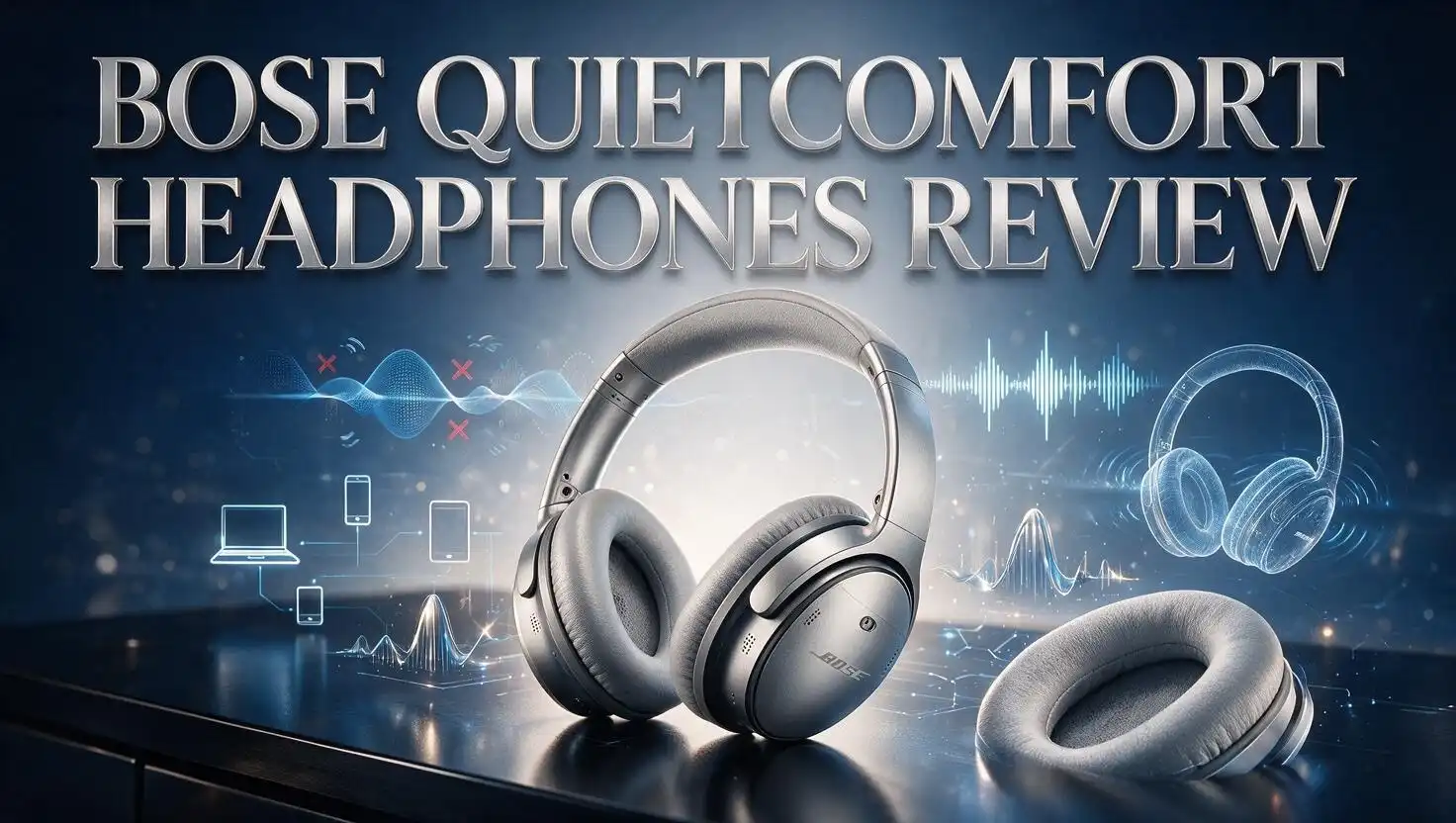
Bose QuietComfort Headphones Review: Comfort and Quiet?
Some headphones chase specs. Others chase feelings. The Bose QuietComfort Headphones chase the feeling of a quiet room, and they catch it almost every time.
You slip them on, press one button, and the airplane engine fades. The office chatter softens. Your shoulders drop a little.
That trick made Bose famous decades ago. The question in 2026 is simple. Do these classic QuietComfort cans still earn a spot on your head when Sony, Sennheiser, and Apple keep swinging?
I spent weeks with them on flights, at desks, on walks, and during long editing sessions. This review covers the comfort, the quiet, the sound, the battery, the app, the weak spots, and the alternatives worth checking.
By the end, you will know exactly who these headphones suit and who should spend money elsewhere.
In a Nutshell
Here is the fast version for readers who want the verdict before the details.
- Comfort is the headline feature. These weigh roughly 240 grams. The plush earcups and soft headband let you wear them for six hours without soreness. Very few rivals match this.
- Noise cancellation ranks near the top. Bose kills low rumble from engines, trains, air conditioners, and traffic with ease. Adjustable modes let you pick how much silence you want.
- Sound is warm, smooth, and bass forward. Vocals sit clean in the middle. The EQ inside the Bose Music app lets you tune bass, mid, and treble to taste.
- Battery life reaches about 24 hours with noise cancellation running. A 15 minute quick charge adds roughly 2.5 hours of playback, which saves you before a flight.
- The feature list stays basic. You get SBC and AAC codecs only, no LDAC, no aptX, and no spatial audio on this model. Audiophiles chasing hi res wireless should look at the Ultra version.
- Value is strong at street prices. The list price sits near $349, but real prices often land between $199 and $249, which turns these into a bargain.
Bose QuietComfort Headphones Overview

- NOISE CANCELLING HEADPHONES: Effortlessly combines noise cancellation technology with passive features so you can...
- COMFORTABLE HEADPHONES: Plush over-ear cushions softly hug your ears, while a secure and comfortable padded band...
- 2 LISTENING MODES: These wireless Bluetooth headphones feature Quiet and Aware Modes that let you toggle between...

Last update on 2026-06-07 / Affiliate links / Images from Amazon Product Advertising API
The Bose QuietComfort Headphones arrived as the direct successor to the beloved QuietComfort 45. Bose kept the shape, kept the weight, and upgraded the brains inside.
The big change is adjustable noise cancellation. Older models gave you two fixed settings. This model gives you a slider plus custom modes you build yourself.
Bose also added CustomTune technology. The headphones play a short tone when you put them on and measure how that tone bounces inside your ear.
The result is calibration that matches your ear shape. Two people wearing the same pair get slightly different tuning, and both sound better for it.
The design stays classic. You get a slim headband, oval earcups, matte plastic, and physical buttons instead of touch panels.
Physical buttons matter more than people admit. Gloves work. Rain works. Accidental swipes never happen.
Battery life reaches around 24 hours with noise cancellation active. Charging runs through USB C, which finally replaced the old micro USB era.
The headphones fold flat and then fold inward, so the carry case stays small. That case slides into a backpack pocket without a fight.
Colors include Black, White Smoke, Cypress Green, Chilled Lilac, and several limited shades. Bose refreshes the palette often, so check current stock.
This is a mature product built on decades of tuning. It does not try to be the flashiest option. It tries to be the pair you actually reach for.
What Comes Inside the Box
Bose keeps the unboxing simple and useful. Nothing feels wasted, and nothing feels cheap.
You get the headphones themselves, folded neatly inside a semi rigid zip case. The case uses a fabric exterior with a molded shell underneath.
Inside the case sits a small mesh pocket. That pocket holds your cables and keeps them from scratching the earcups.
You get a USB C charging cable in a short length. Roughly 12 inches, which suits a laptop but frustrates anyone charging from a wall outlet across the room.
You also get a 2.5mm to 3.5mm audio cable for wired listening. This matters for airplane entertainment systems, studio gear, and phones with headphone jacks.
Wired mode works even when the battery dies, though noise cancellation stops without power. Music still plays, which beats total silence.
Bose includes basic paperwork and a safety guide. No airline adapter ships in the box anymore, which is a small annoyance for frequent flyers.
The packaging itself uses recycled cardboard with minimal plastic. Bose has been trimming waste across its lineup for a few years now.
First impressions land well. The headphones feel lighter in hand than photos suggest.
The hinges move with a smooth damped motion. Nothing rattles, nothing squeaks, and nothing feels hollow.
That said, the materials are plastic rather than metal. Bose uses glass filled nylon in the headband arms for strength without weight.
Design and Build Quality
Bose chose function over fashion here, and that choice pays off daily. These look like professional tools rather than jewelry.
The earcups swivel flat and rotate inward. That dual fold makes the case roughly 30 percent smaller than rivals with single fold designs.
The headband slider uses metal arms with printed size markers. You find your setting once and it stays put through weeks of use.
Controls sit on the right earcup. A volume up button, a volume down button, and a multifunction button handle playback and calls.
The left earcup carries the power and Bluetooth switch. Slide it right and hold to pair, tap it to check battery.
There is one shortcut button on the right cup. You assign it to cycle modes, launch Spotify, or trigger your voice assistant.
The button layout takes about a day to memorize. After that, you operate everything without looking or pulling out your phone.
Build quality holds up under real abuse. The plastic resists fingerprints, and the earpads use a synthetic leather that wipes clean.
Earpads are replaceable, which extends the life of the product by years. Bose sells them directly, and third party options exist too.
One weakness stands out. There is no official IPX water resistance rating.
Light sweat and drizzle cause no harm in practice. Heavy rain or gym sessions are a different story, so treat them as indoor and commuter gear.
Comfort and Fit for Long Sessions
This is where Bose beats almost everyone, and it is not close. Comfort is the entire reason the QuietComfort name exists.
The headphones weigh roughly 240 grams, or about 8.5 ounces. The Sony flagship sits near 250 grams, and the AirPods Max weighs more than double.
Clamping force stays gentle. The cups hold position without squeezing your jaw or pressing your temples.
The earpads use soft memory foam wrapped in protein leather. They compress slowly and mold to your head shape.
Oval openings give real space around the ear. My ears never touched the internal driver mesh, which is a common complaint on cheaper models.
The headband uses a padded strip rather than a full cushion. That sounds worse on paper but works well because the headphones weigh so little.
I wore these for a seven hour work day with two short breaks. No hot spots formed on the crown, and no ache built up behind my ears.
Glasses wearers get good news. The foam seals around temple arms without pressing the frames into your skull.
Heat buildup happens eventually, as it does with any closed back design. After three hours in a warm room, your ears feel a little warm.
A quick lift of one cup solves that instantly. In air conditioned spaces or on planes, the issue rarely appears.
Long haul flyers should treat this as the main selling point. Comfort over 10 hours matters more than a slightly better frequency response.
Top 3 Alternative for Bose QuietComfort Headphones
Great headphones deserve honest competition. These three models challenge the QuietComfort in different ways, and one of them may suit you better.

- THE BEST NOISE CANCELLATION: Powered by advanced processors and an adaptive microphone system, the WH-1000XM...
- CO-CREATED WITH MASTERING AUDIO ENGINEERS: Developed in collaboration with world-renowned mastering audio...
- HD NOISE CANCELING PROCESSOR QN3: The HD Noise Canceling Processor QN3 is 7x faster than the QN1 (found in our...
Last update on 2026-06-07 / Affiliate links / Images from Amazon Product Advertising API

- Seamless Firmware & App Updates: Enjoy a smoother, more reliable experience with the latest firmware and Smart...
- Audiophile-Inspired Sound : Sennheiser wireless headphones over ear with Signature Sound, 42mm transducers and aptX...
- Personalized Listening Experience: Tailor your sound on the over ear headphones wireless via the Smart Control Plus...
Last update on 2026-07-31 / Affiliate links / Images from Amazon Product Advertising API

- ULTIMATE OVER-EAR LISTENING EXPERIENCE — Apple-designed dynamic driver provides high-fidelity audio...
- FIVE FRESH COLORS — AirPods Max come in five fresh colors: Midnight, Starlight, Blue, Purple, and Orange. A...
- FOCUS ON WHAT’S PLAYING — Pro-level Active Noise Cancellation removes up to 2x more background noise, so you...
Last update on 2026-07-31 / Affiliate links / Images from Amazon Product Advertising API
The Sony WH1000XM6 is the technical champion. It supports LDAC for high resolution wireless audio, offers stronger app customization, folds again after Sony skipped folding on the previous model, and delivers around 30 hours of battery.
Sony also leads on adaptive features. The headphones sense whether you sit, walk, or travel and adjust noise cancellation automatically.
Choose Sony if you want maximum control and the most detailed sound.
The Sennheiser Momentum 4 wins on stamina and tone. Battery life reaches roughly 60 hours, which is more than double the Bose figure.
Sennheiser tunes its drivers with a wider soundstage and crisper treble. Audio purists often rank it above both Bose and Sony for pure listening.
Choose Sennheiser if battery life and sound accuracy matter most.
The Apple AirPods Max suits people locked inside the Apple ecosystem. Spatial audio with head tracking, instant device switching, and Find My support create a smooth experience.
The tradeoff is weight and price. These are heavy, expensive, and awkward without an iPhone or Mac.
Choose Apple if your devices all carry an Apple logo.
Noise Cancellation Performance
Bose built its reputation on silence, and this model protects that reputation well. Low frequency cancellation is outstanding.
Airplane cabin rumble drops away almost completely. Bus engines, train hum, refrigerator noise, and air conditioning vanish into the background.
Road noise inside a car falls to a soft whisper. You can hold a conversation without raising your voice much.
Mid frequency handling stays strong too. Office chatter, keyboard clicks, and hallway footsteps fade into a soft blur.
High frequency sounds get through more easily. Sharp voices, clinking dishes, and baby cries still reach your ears at reduced volume.
No headphone on the market blocks those completely, so this is normal physics rather than a Bose flaw.
The adjustable modes make this model shine. Quiet Mode gives maximum cancellation. Aware Mode pipes outside sound straight through.
You can build custom modes between those extremes. I made one called Cafe with cancellation at roughly 60 percent, which softens noise without total isolation.
Aware Mode deserves specific praise. Voices sound natural rather than tinny, and you can order coffee without removing the headphones.
There is a wind block setting inside Aware Mode. It reduces the roaring sound when you walk outdoors on a breezy day.
Cabin pressure suck is minimal. Some strong ANC headphones create an odd pressure feeling, and Bose keeps that sensation very low here.
Sound Quality and Tuning
Bose tunes these for enjoyment rather than studio neutrality. That choice will please most listeners and frustrate a few.
Bass carries real weight and punch. Kick drums hit with authority, and bass guitar lines stay defined instead of turning into mush.
The low end never drowns the rest of the mix. Bose keeps enough control that rock and jazz remain balanced.
Mids sound warm and slightly forward. Vocals sit right in front of you, which makes podcasts and acoustic tracks a pleasure.
Treble stays smooth and polite. Cymbals shimmer without hissing, and long listening sessions never cause fatigue.
That polite treble costs you some sparkle and micro detail. Sennheiser and Sony reveal more texture in busy recordings.
Soundstage is average for a closed back design. Instruments sit inside your head rather than around you, which is typical at this price.
The Bose Music app includes a three band EQ with presets. Bass, Mid, and Treble sliders let you shape the signature quickly.
Adding two clicks of treble and pulling bass down slightly produced my favorite balance. The app also offers Bass Boost, Treble Boost, and Bass Reducer presets.
CustomTune calibration runs every time you power on. The tuning adapts to your ear canal, which improves consistency across different head shapes.
Codec support is the weak spot. You get SBC and AAC only, with no LDAC, no aptX Adaptive, and no LC3.
Android users lose out slightly here. AAC performs well on iPhone but behaves inconsistently across Android devices.
Battery Life and Charging
Bose quotes up to 24 hours of playback with noise cancellation active. Real world testing landed close to that figure.
At moderate volume with ANC in Quiet Mode, I averaged 22 to 23 hours. Higher volumes trimmed that to roughly 20 hours.
That covers a full week for most commuters. Two hours daily means charging once every ten days or so.
Heavy users and long haul travelers may want more. Sennheiser offers 60 hours, and Sony delivers 30, so Bose sits behind both.
Quick charging saves the day when you forget. Fifteen minutes on the cable adds around 2.5 hours of listening.
A full charge takes about 2.5 hours from empty. Charging runs over USB C, and you can use any standard phone charger.
You cannot listen over USB C audio on this model. Charging works while wired listening happens through the 3.5mm cable instead.
The headphones announce battery level when you power them on. The app shows an exact percentage, which beats guessing from a voice prompt.
Auto off timers help too. Set the headphones to sleep after 5, 20, 40, or 180 minutes of inactivity.
Standby drain stays low. I left them in a bag for four days and lost only a few percentage points.
Battery health should last several years with normal use. Bose does not offer user replaceable batteries, which is worth noting for long term ownership.
Bluetooth Connectivity and Multipoint
Connection quality feels stable and boring, which is exactly what you want. Bluetooth 5.1 handles the link.
Range reaches roughly 30 feet indoors through one wall. Open spaces stretch that considerably further.
I walked around a two bedroom apartment without a single dropout. Crowded train stations caused occasional stutters, which affects every wireless headphone.
Multipoint pairing works well. You connect two devices at the same time and switch between them automatically.
Music plays from your laptop, then a call arrives on your phone. The headphones switch over and return to your music afterward.
The app lets you manage a list of paired devices. Tap a name to connect, or swipe to remove old devices you no longer own.
The headphones remember up to seven devices in memory. That covers a phone, laptop, tablet, work computer, and console with room to spare.
Pairing itself takes seconds. Slide the power switch right and hold, then pick Bose QuietComfort from your Bluetooth list.
Latency stays acceptable for video. YouTube, Netflix, and streaming apps sync well because those platforms compensate automatically.
Gaming is a different story. AAC latency runs high enough that fast paced shooters feel slightly off.
Casual games work fine. Competitive players should use a wired connection or a low latency dongle setup instead.
There is no Bluetooth LE Audio or Auracast support on this model. Bose reserved those newer standards for its Ultra line.
The Bose Music App and Controls
The Bose Music app runs on iOS and Android and stays refreshingly simple. Setup takes about two minutes.
The home screen shows battery level, active mode, and connected devices. Everything sits within one or two taps.
Mode management is the star feature. You create custom listening modes, name them, and set noise cancellation levels between 0 and 10.
I built three modes. Flight at level 10, Office at level 7, and Walk with Aware Mode active.
Cycling between them takes one press of the shortcut button. That workflow beats digging through menus.
The EQ section offers presets plus manual sliders. Changes apply instantly, and you can hear the difference while adjusting.
You assign the shortcut button in settings. Options include mode cycling, voice assistant activation, and Spotify Tap.
Firmware updates arrive through the app. Bose has shipped several updates since launch, adding refinements and fixing small bugs.
Self voice adjustment helps during calls. You choose how much of your own voice you hear, which stops the shouting problem.
The app also handles product tips and a support section. Nothing here feels bloated or pushy.
Physical controls remain the fastest way to work. Volume buttons sit under your thumb, and the multifunction button handles play, pause, skip, and answer.
One press plays or pauses. Two presses skip forward. Three presses skip back.
Muscle memory forms quickly, and the tactile clicks give confidence that your press registered.
Bose QuietComfort Ultra Headphones Comparison

- SPATIAL AUDIO HEADPHONES: Bose QuietComfort Ultra Headphones with spatial audio give you an immersive experience...
- NOISE CANCELING HEADPHONES: These wireless noise cancelling headphones feature Quiet Mode, Aware Mode and Immersion...
- HEADPHONES WITH MIC: Microphones focus on the sound of your voice and the bluetooth headphones with microphone...
Last update on 2026-07-31 / Affiliate links / Images from Amazon Product Advertising API
Bose sells the QuietComfort Ultra above this model, and the differences deserve a clear breakdown.
Immersive Audio is the flagship feature. The Ultra creates a spatial effect that places sound in front of you rather than inside your head.
Head tracking anchors that soundstage in place. Turn your head and the audio stays fixed, like real speakers in a room.
The effect works well for movies and live recordings. Studio pop tracks benefit less, and the feature costs battery life.
The Ultra supports aptX Adaptive for higher quality streaming on compatible Android phones. The standard QuietComfort sticks with SBC and AAC.
Controls differ too. The Ultra uses a touch strip for volume alongside physical buttons, which some people love and others find fussy.
Noise cancellation is very close between the two. The Ultra edges ahead slightly in higher frequencies, but the gap is small in daily use.
Battery life favors the standard model in one sense. The Ultra gives 24 hours normally but drops to roughly 18 hours with Immersive Audio active.
Comfort is nearly identical. Both use the same general shape, and both weigh roughly the same.
Price separates them most. The Ultra lists near $429 while the standard model lists near $349, and street prices widen that gap further.
Bose also released a second generation Ultra with longer battery life, USB C lossless audio, and a Cinema mode.
Buy the Ultra if spatial audio excites you. Buy the standard model if you want quiet and comfort for less money.
Pros and Cons of Bose QuietComfort Headphones
Every product involves tradeoffs. Here is the honest scorecard after weeks of daily use.
Pros
- Best in class comfort with 240 gram weight and gentle clamping force that supports all day wear
- Excellent low frequency noise cancellation that erases engine rumble, traffic, and office hum
- Adjustable ANC levels with custom modes you name and save inside the app
- Warm and enjoyable sound with strong bass, clear vocals, and no listening fatigue
- Physical buttons that work with gloves, in rain, and without accidental triggers
- Compact folding design with a slim case that fits real bags
- Solid 24 hour battery plus a 15 minute quick charge for 2.5 hours of playback
- Reliable multipoint pairing across two devices at once
- Replaceable earpads that extend the useful life of the headphones
- Frequent discounts that push street prices far below list
Cons
- No LDAC or aptX support, which limits high resolution wireless audio
- No spatial audio on this model, unlike the Ultra version
- No USB C audio playback, so wired listening needs the analog cable
- Battery trails rivals offering 30 to 60 hours
- No official water resistance rating, so gym use carries risk
- Plastic construction feels practical rather than premium at the list price
- Higher frequency noise leaks through more than very low frequencies
- Latency affects competitive gaming on wireless connections
The cons are real, but most affect specialists rather than everyday listeners.
Who Should Buy These Headphones
Some people will love these immediately. Others should spend their money differently.
Frequent flyers should buy these. The combination of light weight, gentle clamp, and deep rumble cancellation makes long flights genuinely pleasant.
Office workers benefit enormously. Open plan noise disappears, calls sound clean, and the headphones stay comfortable through back to back meetings.
Students studying in libraries and cafes get a focused bubble without the ear fatigue that heavier models cause.
People with sensitive ears or glasses should shortlist these. The soft pads and low clamping force reduce pressure points better than most rivals.
Remote workers on video calls get reliable microphones and multipoint switching between laptop and phone.
Now the other side.
Audiophiles chasing maximum detail should look at Sennheiser or Sony. The Bose tuning prioritizes smoothness over resolution.
Android users who want high resolution wireless should choose LDAC capable models. The lack of advanced codecs limits the ceiling here.
Gym users need something sweat resistant. No IPX rating means these belong indoors and on commutes.
Competitive gamers need lower latency. A wired headset or a dedicated gaming model will serve better.
Anyone who wants spatial audio should step up to the Ultra. The feature simply does not exist on this model.
Budget shoppers should watch for sales. These drop below $200 during major shopping events, which changes the value calculation completely.
Price and Value for Money
The list price sits around $349, which places these squarely in flagship territory. At that price, the value looks merely fine.
Street prices tell a much better story. Amazon regularly lists these between $199 and $249, and holiday sales push lower.
At $199, these become one of the strongest buys in wireless audio. You get flagship comfort and flagship noise cancellation for midrange money.
Compare that against the Sony WH1000XM6 at roughly $400 and the AirPods Max at roughly $500. The savings are substantial.
The tradeoff is features rather than fundamentals. You give up codecs and spatial audio, not comfort or quiet.
Long term value looks good too. Replaceable earpads mean you can refresh worn cushions instead of buying new headphones.
Bose warranty coverage runs one year in most regions. The company has a solid reputation for handling repairs and replacements.
Resale value holds up better than most brands. Used QuietComfort models still fetch reasonable prices years after release.
Consider the cost per hour of use. At $199 across three years of daily commuting, these cost pennies per session.
Refurbished units from Bose directly offer another route. Certified refurbished pairs often sell 20 to 30 percent below new prices with warranty included.
My advice is straightforward. Do not pay full list price. Set a price alert, wait for a sale, and buy at $249 or lower.
Final Verdict
The Bose QuietComfort Headphones do one thing extremely well and several things very well. That focus is their strength.
Comfort remains unmatched at this weight class. You forget you are wearing them, which is the highest compliment a headphone can earn.
Noise cancellation delivers on the promise. Low rumble disappears, and the adjustable modes give you control that fixed setting rivals lack.
Sound is warm, enjoyable, and easy to live with. It will not win technical shootouts, but it will make your commute better every day.
The missing pieces are real. No LDAC, no spatial audio, no USB C audio, and a battery that trails the competition.
Those gaps matter to enthusiasts and barely register for everyone else.
I rate these 4.4 out of 5. The score would drop at full list price and rise at deep discount.
Buy them if you value comfort and quiet above spec sheets. Buy them if you fly often, work in noise, or wear headphones for hours.
Skip them if you need high resolution wireless audio, spatial sound, or gym durability.
Bose built a tool rather than a showpiece. It works, it lasts, and it stays comfortable.
After weeks of testing, these stayed on my desk rather than in a drawer. That says more than any measurement chart.
Frequently Asked Questions
Are the Bose QuietComfort Headphones worth buying in 2026?
Yes, especially at discounted prices. Comfort and noise cancellation remain top tier, and street prices near $199 make the value excellent.
Newer rivals offer better codecs and longer battery, but few match the all day comfort.
How long does the battery last on Bose QuietComfort Headphones?
You get up to 24 hours with noise cancellation active. Real world use lands around 22 hours at moderate volume.
A 15 minute quick charge adds roughly 2.5 hours of playback.
Do Bose QuietComfort Headphones support LDAC or aptX?
No. These support SBC and AAC only.
The QuietComfort Ultra adds aptX Adaptive for compatible Android devices.
Can you use Bose QuietComfort Headphones while charging?
You can charge them and listen through the included 3.5mm analog cable at the same time.
USB C audio playback is not supported on this model.
Are Bose QuietComfort Headphones good for calls?
Yes for most situations. The microphone array picks up your voice clearly in quiet and moderately noisy places.
Heavy wind and loud crowds reduce clarity, which is common across the category.
What is the difference between QuietComfort and QuietComfort Ultra?
The Ultra adds Immersive Audio with head tracking, aptX Adaptive support, and a touch volume strip.
The standard model costs less and gives nearly identical comfort and noise cancellation.
Are Bose QuietComfort Headphones waterproof?
No. There is no official IPX rating.
Light sweat and drizzle cause no harm, but avoid heavy rain and gym workouts.
Can Bose QuietComfort Headphones connect to two devices at once?
Yes. Multipoint pairing connects two devices simultaneously and switches automatically when a call arrives.
You manage the device list inside the Bose Music app.

Meet Amelia, the adventurous soul behind TravelersEnthusiasm.com. With a heart set on exploration, she crafts tales that whisk readers from European alleys to Asian landscapes. Amelia‘s stories are genuine, reflecting her deep connections and reverence for diverse cultures. When not traveling, she’s sketching in cafes or exchanging tales with fellow wanderers.


