
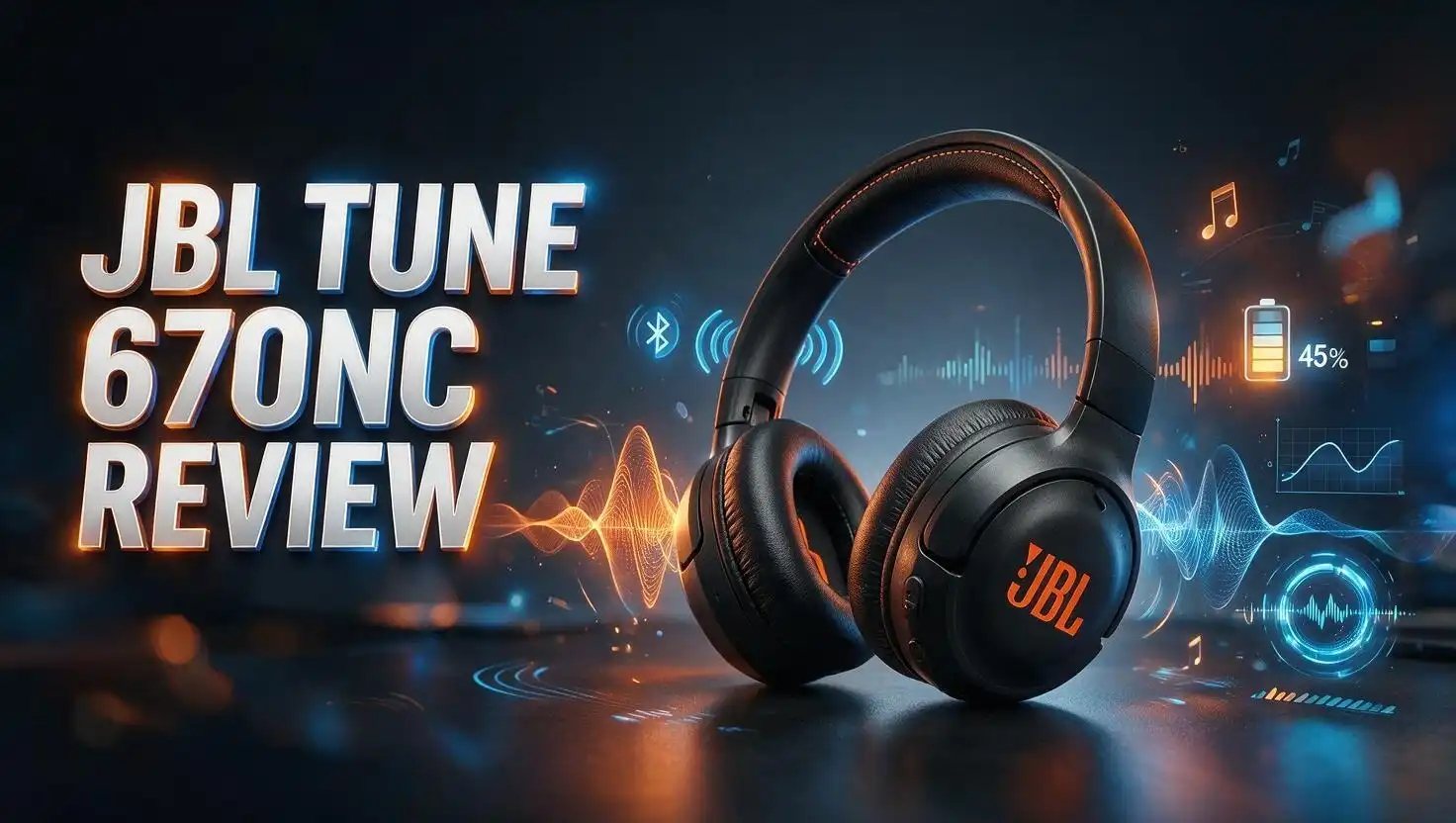
JBL Tune 670NC Review: Big Battery, Real Noise Cancelling?
JBL keeps making budget headphones that punch above their price. The JBL Tune 670NC is one of the clearest examples. It costs far less than the big names, yet it carries adaptive noise cancelling, 70 hours of battery life, Bluetooth 5.3, and multi point pairing.
That feature list looks almost unfair for the money. But specs on a box never tell the full story. Comfort, sound balance, and real world noise blocking decide whether headphones stay on your head or stay in a drawer.
This review breaks down every part of the Tune 670NC in plain language. You will learn how it sounds, how long it really lasts, who it fits best, and where it falls short. By the end, you will know if this pair belongs in your bag.
In a Nutshell
Here is the short version for readers who want the verdict fast.
- Battery life is the headline feature. JBL rates the Tune 670NC at 70 hours with noise cancelling switched off and 44 hours with it switched on. A 5 minute charge adds 3 hours of playback, and a full charge takes about 2 hours over USB C.
- Adaptive noise cancelling actually works. Two microphones handle the job. The system flattens engine rumble, air conditioner hum, and bus noise very well. Sharp sounds like keyboard clicks and voices still slip through, which is normal at this price.
- The sound leans warm and bass forward. JBL Pure Bass tuning through 32mm drivers gives kick drums and bass lines real weight. The free JBL Headphones app lets you flatten or reshape that curve with a custom EQ.
- It is genuinely light. The whole set weighs 174 grams, or about 6.1 ounces. The flat fold hinges make it easy to slide into a backpack pocket.
- It is an on ear design, not over ear. The cushions press against your ears rather than surround them. Most people stay comfortable for two or three hours, then want a short break.
- Value is the real selling point. List price sits near $109.95, but street prices often land between $50 and $80. At that range, very little else offers this mix of battery, app control, and adaptive ANC.
JBL Tune 670NC Review at a Glance

- Adaptive Noise Cancelling with Smart Ambient
- Adaptive Noise Cancelling means zero distractions when it's time to focus on your studies—or get your groove on...
- Bluetooth 5.3 with LE Audio*

Last update on 2026-07-31 / Affiliate links / Images from Amazon Product Advertising API
The JBL Tune 670NC sits in the middle of the JBL Tune family. It replaced the older Tune 660NC and brought several meaningful upgrades with it.
The driver setup uses 32mm dynamic drivers with a frequency response of 20 Hz to 20 kHz. Impedance is 32 ohms and sensitivity is 98 dB, so your phone drives these easily.
Bluetooth 5.3 handles the wireless link. JBL also promises LE Audio support through a future firmware update, which should improve efficiency and latency on compatible phones.
The feature that surprises most buyers is multi point connection. You can pair a laptop and a phone at the same time and switch between them without digging through settings menus.
JBL includes a detachable 1.2 meter audio cable in the box. That means you can plug into airplane entertainment systems or wired gear when the battery dies.
The headphones fold flat and also fold inward at the hinges. No carrying case ships with them, which is the most common complaint from owners.
Controls live on the right ear cup as physical buttons. Physical buttons beat touch panels for reliability, especially with cold hands or gloves.
Colors include black, white, blue, and purple. The finish is matte plastic with a soft touch feel on the headband.
Nothing here feels premium in the metal and leather sense. Everything here feels smart for the money, which is the point of the Tune line.
Design and Build Quality
The Tune 670NC is built almost entirely from plastic. That sounds like a criticism, but the choice keeps the weight at just 174 grams.
The ear cups measure 7.3cm across and 3.7cm deep. They sit on your ears rather than around them, which defines the whole listening experience.
The headband uses a padded strip along the top. Padding is thin compared with over ear models, but the light frame keeps pressure low on the crown of your head.
Adjustment sliders click firmly into place and hold their position well. The hinges rotate smoothly and show no creaking during normal handling.
Build quality feels solid for the class. The plastic flexes without alarming cracking sounds, and the headband survives being twisted a fair amount.
Ports are simple. You get a USB C charging port and a 3.5mm jack for the detachable cable, both on the same ear cup.
The flat fold design is the practical star here. The cups swivel flat so the headphones lie against your chest or slide into a laptop sleeve.
The lack of a case still stings. A soft pouch would cost JBL almost nothing and would protect the ear cushions during travel.
Ear cushions use protein leather over foam. They feel soft out of the box, though this material tends to flake after a couple of years of heavy use.
Overall, the design says practical rather than luxurious. For a pair you toss in a bag every day, practical wins.
Comfort and Fit
Comfort is where on ear headphones divide opinion, and the Tune 670NC follows that pattern exactly.
The clamping force is moderate. It holds firm enough for walking and light exercise without squeezing your head.
Light weight helps enormously here. At 174 grams, you often forget the headphones are on during the first hour.
The problem is pressure on the outer ear itself. Because the cushions rest on your ears, warmth and soreness build slowly over long sessions.
Most listeners report two to three comfortable hours before wanting a short break. That matches typical on ear behavior across brands.
Glasses wearers actually do reasonably well with this pair. Several owners mention that the soft cushions do not press frames painfully into the sides of their heads.
Heat buildup is lower than with over ear models. Less material covers your ears, so airflow keeps things cooler during summer commutes.
The headband rarely creates a hot spot. Weight distribution stays even across the arc, which prevents the top of the head ache that heavier models cause.
For gym use, the fit holds during walking, cycling, and light cardio. Hard running shifts them slightly, and there is no official water resistance rating.
If you plan eight hour work sessions with headphones glued to your ears, an over ear pair suits you better. For commutes, classes, errands, and travel, the fit works fine.
Sound Quality and JBL Pure Bass
JBL tunes the Tune 670NC for fun rather than neutrality, and the brand makes no secret of that.
The 32mm drivers deliver a bass forward signature with strong emphasis in the low end. Hip hop, electronic music, and pop tracks sound full and energetic.
Sub bass reaches lower than you expect from an on ear design. Bass lines in tracks like Billie Eilish songs land with real physical weight.
Mids sit slightly behind the bass in the default tuning. Vocals stay clear, but they do not step forward the way they do on neutral studio headphones.
Treble is smooth rather than sparkling. Cymbals and hi hats stay present without harshness, which reduces listening fatigue over long stretches.
Detail retrieval is decent for the price but not remarkable. Busy orchestral or metal tracks can sound slightly congested during loud passages.
Soundstage is narrow, which is typical for closed back on ear headphones. Instruments feel close to your head rather than spread across a room.
The EQ in the JBL Headphones app fixes a lot of this. Pulling the bass down two or three decibels and lifting the upper mids produces a much more balanced sound.
Volume goes plenty loud from a phone. Distortion stays controlled until you push near maximum levels.
Wired listening through the detachable cable sounds slightly flatter and cleaner. It is a useful option for airplanes or for saving battery.
For casual listening, podcasts, and streaming, the sound quality clearly exceeds what the price suggests.
Top 3 Alternatives for JBL Tune 670NC
Before you commit, three other models deserve a look in the same price neighborhood.

- SONY’S LIGHTEST WIRELESS NOISE CANCELING HEADBAND EVER: Weighing just 192g, our lightest overhead wireless...
- DUAL NOISE SENSOR TECHNOLOGY: Take noise canceling to the next level with Sony’s Integrated Processor V1, so you...
- ALL DAY COMFORT: Super comfortable and lightweight design.
Last update on 2026-06-07 / Affiliate links / Images from Amazon Product Advertising API
The Sony WH CH720N is the closest rival. It uses an over ear design, weighs just 192 grams, and includes Sony’s Integrated Processor V1 for noise cancelling. Battery life reaches about 35 hours, which is much lower than the JBL, but the over ear fit stays comfortable far longer during marathon sessions.

- 98% Less Noise for Your Journey: The fully-upgraded noise cancelling system targets and blocks out a wider range of...
- Make Every Space Your Own: Whether you're indoors, outdoors, commuting, or on a flight, Space Q45's adaptive noise...
- Ideal for Traveling: 50 hours of playtime in noise cancelling mode will cover an around-the-world flight without...
Last update on 2026-07-31 / Affiliate links / Images from Amazon Product Advertising API
The Soundcore Space Q45 from Anker targets buyers who want maximum noise blocking. Anker claims noise reduction of up to 98 percent with a multi microphone system. It also supports LDAC for higher resolution wireless audio and delivers around 50 hours of playtime with ANC switched on. It costs more than the Tune 670NC but often drops near $100 during sales.

- JBL Pure Bass Sound: The JBL Tune 720BT features the renowned JBL Pure Bass sound, the same technology that powers...
- Wireless Bluetooth 5.3 technology: Wirelessly stream high-quality sound from your smartphone without messy cords...
- Customize your listening experience: Download the free JBL Headphones App to tailor the sound to your taste with...
Last update on 2026-07-31 / Affiliate links / Images from Amazon Product Advertising API
The JBL Tune 720BT suits listeners who do not care about active noise cancelling. It offers the same JBL Pure Bass tuning, an over ear fit, Bluetooth 5.3, and up to 76 hours of battery. Skipping ANC keeps the price lower while giving you a roomier and cooler fit than the on ear 670NC.
Each option trades something away. Sony trades battery for comfort, Anker trades price for stronger ANC, and the Tune 720BT trades noise cancelling for a bigger, cheaper over ear design.
Adaptive Noise Cancelling Performance
Adaptive noise cancelling is the feature that justifies the NC in the model name, so expectations matter here.
The system uses two microphones and adjusts filtering based on the noise around you and the seal on your ears.
Low frequency noise is where it performs best. Airplane cabin drone, bus engines, train rumble, and air conditioning hum drop dramatically.
Mid frequency noise reduction is moderate. Traffic noise softens, though car horns and tire noise still register clearly.
High frequency sounds pass through most easily. Nearby conversations, keyboard clicks, and cafe clatter remain audible even at full strength.
That pattern is normal for headphones in this class. Premium models from Bose and Sony do better in the mid range, and they cost three or four times more.
The on ear design also limits passive isolation. Over ear cups create a physical seal that blocks noise before the electronics even start working.
Cabin pressure sensation is mild. Some people feel a slight ear pressure with ANC on, but reviewers generally describe the effect on this model as gentle.
You can toggle noise cancelling from the ear cup button or from the app. The transition is quick and free of loud clicks or pops.
Turning ANC on shifts the sound slightly. Bass tightens a little and the overall presentation feels marginally thinner, which is a common trade.
For students in libraries, office workers, and commuters, the performance handles the job well. Frequent flyers who need silence will still prefer over ear premium options.
Ambient Aware and TalkThru Modes
JBL includes two transparency style modes, and they serve different purposes.
Ambient Aware pipes outside sound into the headphones while your music keeps playing at normal volume.
This mode helps when you walk near traffic or wait for a train announcement. You stay aware of your surroundings without pulling the headphones off.
TalkThru works differently. It lowers your music volume sharply and boosts voice frequencies so you can hold a quick conversation.
Ordering coffee, answering a coworker, or checking in at a desk becomes simple. The mode switches back with one button press.
Sound quality in these modes is decent but not natural. Outside audio carries a slight electronic hiss, which is standard for budget transparency systems.
Wind noise can trigger unwanted rushing sounds in Ambient Aware. Walking on a breezy day exposes this weakness quickly.
You control both modes through the JBL Headphones app or through the physical button on the ear cup.
The app lets you choose which modes cycle through the button press. If you never use TalkThru, you can remove it from the rotation.
Latency is low when switching. The change happens almost instantly, which keeps the feature usable in real conversations.
These features are not as polished as the transparency mode on flagship headphones. They still deliver real convenience during daily errands and short chats.
Battery Life and Speed Charge
Battery life is the strongest argument for buying the Tune 670NC over almost any rival.
JBL rates the headphones at 70 hours with Bluetooth on and noise cancelling off. That figure is enormous for the category.
With adaptive noise cancelling active, the rating drops to 44 hours. Even that number beats most competitors running with ANC switched off.
Real world results track closely with the claims. Owners regularly report charging once every two or three weeks with daily commute use.
Charging takes about 2 hours from empty over USB C. That is reasonable given the battery capacity involved.
Speed charge adds 3 hours of playback from a 5 minute plug in. This feature saves you when you notice a dead battery right before leaving home.
The detachable audio cable acts as a backup. Plug in and keep listening even with a completely flat battery, though ANC will not work.
Standby drain is low. The headphones power down automatically after a period of inactivity, which prevents overnight battery loss.
Battery readout appears in the app and in your phone’s Bluetooth menu on most devices. Voice prompts also announce charge level at power on.
Volume level affects real numbers, as always. Loud listening at high volume shortens run time noticeably compared with moderate levels.
For travelers, this battery removes charging anxiety entirely. A single charge covers a round trip international flight schedule with plenty left over.
Bluetooth 5.3, LE Audio and Multi Point
Connectivity on the Tune 670NC is modern and stable, which matters more than raw codec numbers for most users.
Bluetooth 5.3 handles the connection. Range holds strong at around 10 meters indoors with typical walls between you and your device.
Dropouts are rare. Crowded areas like train stations and gyms occasionally cause brief stutters, but the link recovers fast.
Codec support covers SBC and AAC. There is no aptX or LDAC support, so Android users will not get high resolution wireless streaming here.
For most listeners, AAC sounds perfectly good. Lossless quality matters less on budget headphones than tuning and fit do.
Multi point connection is a standout inclusion at this price. You can connect a laptop and a phone at once and switch instantly when a call arrives.
Setup takes seconds through the JBL Headphones app. The app also lets you disable multi point if you prefer a single stable connection.
JBL promises LE Audio support through an over the air firmware update. LE Audio brings better power efficiency and the LC3 codec on compatible devices.
Latency in default mode is acceptable for video. The app includes a Video mode under Smart Audio and Video that reduces lag further for movies and gaming.
Switching between Audio mode and Video mode takes one tap. Audio mode prioritizes sound quality while Video mode prioritizes sync.
The overall connection experience feels reliable and modern for daily use.
Call Quality and VoiceAware
Call performance sits at an average level for this price bracket, with one genuinely helpful feature.
Two microphones handle voice pickup. In quiet rooms, callers describe your voice as clear and easy to understand.
Noisy environments reveal the limits. Wind, traffic, and background chatter reduce clarity, and your voice can sound slightly compressed.
Video calls on Zoom, Teams, and Google Meet work fine for typical office conversations. Nobody will mistake the microphone for a dedicated headset.
VoiceAware is the standout call feature. It feeds your own voice back into the ear cups while you speak.
That sidetone stops you from shouting during calls, a common problem with closed headphones.
You can adjust the VoiceAware level in the app. Some users prefer a strong feed, and others want just a hint of their own voice.
Call controls sit on the physical buttons. Answering, ending, and rejecting calls all work with simple presses.
Voice assistant support connects to Google Assistant and Siri through your phone. A button press launches your default assistant.
Microphone performance drops during phone calls made outdoors on windy days. Positioning matters little because the mics sit in fixed spots on the cups.
For students, remote workers, and casual callers, the quality is entirely serviceable. Professionals in loud environments should still use a dedicated call headset.
JBL Headphones App and Customization

- Adaptive Noise Cancelling with Smart Ambient: Adaptive Noise Cancelling means zero distractions whether you're...
- Bluetooth 5.3 with LE Audio: Wirelessly stream high-quality JBL Pure Bass Sound. In the JBL Headphones app select...
- JBL Pure Bass Sound: JBL Tune 670NC headphones feature renowned JBL Pure Bass sound-the same that powers the most...
Last update on 2026-07-31 / Affiliate links / Images from Amazon Product Advertising API
The free JBL Headphones app turns these headphones from good into genuinely flexible.
The app is available on iOS and Android. Setup takes under a minute and pairs directly with the connected headphones.
The graphic EQ is the most valuable tool. You get preset curves plus a fully custom option to shape the sound yourself.
Presets include Jazz, Vocal, Bass, and Studio. Each one shifts the tuning noticeably rather than making token adjustments.
Personi Fi 3.0 creates a hearing profile based on a short listening test. The result tailors the frequency response to your own ears.
Ambient sound controls live here too. You can adjust noise cancelling behavior and choose which modes appear in the button cycle.
The Smart Audio and Video toggle switches between the low latency Video mode and the higher quality Audio mode.
Firmware updates arrive through the app. JBL has used these updates to add features and refine ANC behavior over time.
You can also rename the headphones, check battery percentage, and set auto power off timing.
VoiceAware strength and voice prompt language both sit in the settings menu. Turning voice prompts down reduces the chatty startup announcements.
The interface is clean and quick. Some users report occasional connection hiccups when opening the app, though a simple relaunch fixes it.
Skipping the app leaves value on the table. Five minutes of EQ tuning improves these headphones more than any accessory could.
JBL Tune 670NC vs Tune 660NC and Tune 720BT
Choosing between JBL models confuses many buyers, so here is a clear comparison.
The Tune 660NC is the older generation. It offers 55 hours of battery, Bluetooth 5.0, and standard active noise cancelling rather than adaptive.
The Tune 670NC upgrades every one of those points. You gain 15 extra hours of battery, Bluetooth 5.3, LE Audio readiness, multi point pairing, and adaptive ANC.
The 670NC also adds Ambient Aware and TalkThru modes, which the 660NC lacks in its standard form.
Prices for the two models often sit close during sales. When they do, the newer model is the obvious pick.
The Tune 720BT takes a different path. It drops active noise cancelling entirely and uses an over ear design instead.
Battery on the 720BT reaches 76 hours, slightly higher than the 670NC because no ANC circuitry drains power.
Comfort favors the 720BT for long sessions. Over ear cushions surround your ears rather than pressing on them.
Pick the Tune 670NC if noise cancelling matters and portability matters. Its flat fold on ear design travels better than the bulkier 720BT.
Pick the Tune 720BT if you work at a desk for hours and want the cheapest comfortable JBL sound.
Skip the Tune 660NC unless you find it at a steep clearance discount below fifty percent of the 670NC price.
Pros and Cons of the JBL Tune 670NC
Here is the balanced summary after weighing every feature.
Pros
- Battery life reaches 70 hours without ANC and 44 hours with ANC active, which beats nearly every rival at this price.
- Speed charge delivers 3 hours of playback from just 5 minutes plugged into USB C.
- Adaptive noise cancelling handles low frequency rumble from engines, buses, and air conditioning very effectively.
- The 174 gram weight and flat fold hinges make these one of the most portable ANC headphones available.
- Multi point pairing lets you connect a phone and a laptop at the same time, a rare feature under $100.
- The JBL Headphones app includes a full custom EQ, Personi Fi hearing profiles, and firmware updates.
- A detachable 3.5mm cable ships in the box for wired listening and airplane use.
- VoiceAware sidetone stops you from raising your voice during calls.
Cons
- The on ear design causes ear soreness for many listeners after two or three hours of continuous wear.
- No carrying case or pouch is included, which is disappointing for headphones built around travel.
- Noise cancelling struggles with voices, keyboard clicks, and other high frequency sounds.
- Codec support stops at SBC and AAC, so there is no aptX or LDAC for Android listeners.
- Default tuning is heavily bass forward and needs EQ adjustment for balanced listening.
- Build materials are all plastic with no official water or sweat resistance rating.
- Microphone clarity drops noticeably during calls in windy or noisy outdoor conditions.
Who Should Buy the JBL Tune 670NC
These headphones fit certain listeners perfectly and disappoint others, so match them to your habits.
Students get the most value here. Long battery life means charging rarely, and adaptive ANC handles library and dorm noise well.
Commuters benefit strongly too. The flat fold design slides into a backpack, and low frequency noise blocking tames bus and train rides.
Budget shoppers who want app control will love this pair. Very few sub $100 headphones offer custom EQ and hearing profiles.
Travelers who hate charging cables will appreciate the 70 hour rating. One charge covers most trips completely.
Bass lovers get a tuning built for their taste out of the box. No adjustment needed for hip hop and electronic listening.
People with smaller heads often prefer on ear designs. The lighter clamp and reduced bulk suit them better than large over ear cups.
Some buyers should look elsewhere. Anyone who wears headphones for six or eight hour shifts needs an over ear design instead.
Audiophiles chasing neutral tuning and high resolution codecs will find the limits quickly. LDAC support and flatter frequency response live at higher prices.
Frequent long haul flyers who need maximum silence should invest in premium ANC models with stronger mid range cancellation.
Anyone who runs hard or trains intensely needs sweat resistance, which this pair does not officially provide.
Final Verdict
The JBL Tune 670NC delivers an unusual amount of technology for the money, and that defines the whole product.
Battery life alone puts it ahead of most competitors. Seventy hours of playback with a 5 minute speed charge removes charging worry entirely.
Adaptive noise cancelling performs honestly. It flattens rumble and hum effectively while letting sharper sounds through, exactly as you would expect at this level.
Sound quality rewards a few minutes with the app. Default bass runs heavy, but the custom EQ transforms these into a well balanced pair.
Multi point pairing, Bluetooth 5.3, LE Audio readiness, and a detachable cable round out a feature list that shames pricier models.
The on ear fit remains the main compromise. Comfort holds for two or three hours, then most people want a break.
The missing carrying case still feels like an odd cut for travel focused headphones.
At list price near $109.95, the value looks fair. At the common sale price between $50 and $80, the value looks excellent.
Rating: 4.3 out of 5.
Buy the Tune 670NC if you want maximum features per dollar in a light, portable package. Choose an over ear alternative if all day comfort ranks above everything else on your list.
For students, commuters, and budget minded listeners, this pair is one of the smartest purchases in its class.
Frequently Asked Questions
Is the JBL Tune 670NC on ear or over ear?
The Tune 670NC uses an on ear design. The cushions rest on your outer ears rather than surrounding them completely. This keeps the headphones light at 174 grams and helps them fold flat for travel. The trade is comfort during very long sessions.
How long does the JBL Tune 670NC battery last?
JBL rates the battery at 70 hours with noise cancelling switched off and 44 hours with noise cancelling switched on. A full charge takes about 2 hours over USB C. A quick 5 minute charge adds 3 hours of playback time.
Does the JBL Tune 670NC have good noise cancelling?
Yes, for its price. The adaptive system reduces low frequency noise like engine rumble and air conditioner hum very well. It struggles more with voices and other high frequency sounds. Premium models from Sony and Bose still block more, but they cost several times as much.
Does the JBL Tune 670NC support multi point pairing?
Yes. You can connect two Bluetooth devices at the same time and switch between them automatically. Pair a laptop and a phone, then take a call without disconnecting anything manually. You can enable or disable the feature in the JBL Headphones app.
Can you use the JBL Tune 670NC with a cable?
Yes. A detachable 1.2 meter audio cable ships in the box. Plug it into any 3.5mm jack to keep listening when the battery dies. Active noise cancelling will not function in wired mode without battery power.
What codecs does the JBL Tune 670NC support?
The headphones support SBC and AAC over Bluetooth 5.3. There is no aptX or LDAC support. JBL has stated that LE Audio and the LC3 codec will arrive through a future firmware update for compatible devices.
Is the JBL Tune 670NC waterproof or sweat resistant?
No. JBL does not list any IP rating for this model. Light sweat during a walk will not damage them, but you should avoid heavy workouts and rain. Choose a dedicated sport model if you train intensely.
Is the JBL Tune 670NC better than the Tune 660NC?
Yes, in every major area. The 670NC adds 15 hours of battery life, Bluetooth 5.3 instead of 5.0, adaptive noise cancelling, multi point pairing, and Ambient Aware and TalkThru modes. Choose the 660NC only if you find it at a very deep discount.

Meet Amelia, the adventurous soul behind TravelersEnthusiasm.com. With a heart set on exploration, she crafts tales that whisk readers from European alleys to Asian landscapes. Amelia‘s stories are genuine, reflecting her deep connections and reverence for diverse cultures. When not traveling, she’s sketching in cafes or exchanging tales with fellow wanderers.

