
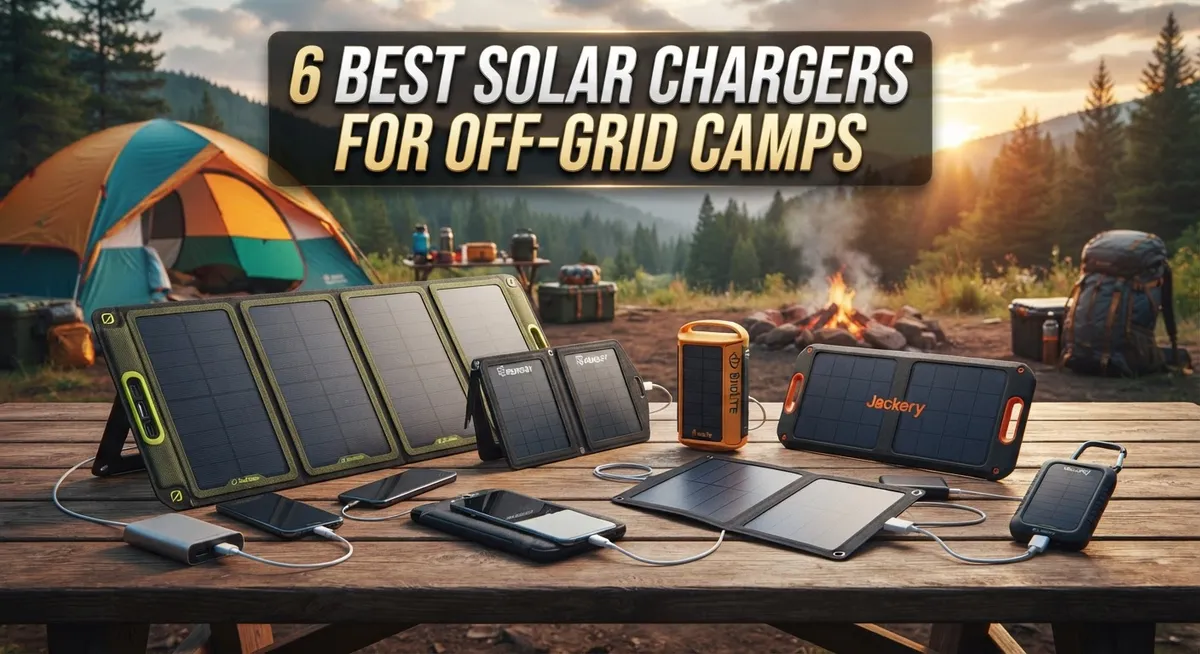
6 Best Solar Chargers for Off-Grid Camps: Top Picks in 2026
Off-grid camping feels amazing until your phone battery dies. You lose your map, your camera, and your only way to call for help.
A good solar charger fixes this problem fast. It captures sunlight and turns it into real power for your gear.
We tested brands like BigBlue, Goal Zero, FlexSolar, and Biolite. We evaluated 19 models to find chargers that actually work in the field.
Some campers need a light charger for a quick phone boost. Others need serious power for months away from civilization.
That’s why we picked 6 top solar chargers for every type of camp. Each one earns its spot through real testing and real results.
You will find compact panels that fold into your backpack easily. You will also find powerful stations built for extended trips.
We looked at portability, charging speed, and battery compatibility. We also checked how each unit handles different wattage needs.
Weather changes. Trips get longer. Your gear list grows every season.
This guide helps you match the right charger to your exact camping style. Keep reading to find your perfect off-grid power partner.
How We Chose Our Top Picks
We tested 19 solar charger models from trusted brands like BigBlue, FlexSolar, Goal Zero, and Biolite. Our team spent weeks evaluating each product in real off-grid camping conditions. We checked how fast they charge your phone, how well they survive weather changes, and whether they actually work when you need them most.
Build quality matters when you’re far from civilization. We examined every charger’s materials, folds, and connections. We also tested how each one plays with battery banks and power stations. Some chargers work great for a quick phone boost. Others handle serious power needs for extended trips.
We focused on three main things: portability that fits your backpack, charging speed that won’t leave you waiting, and real compatibility with the gear you already own. We ignored marketing hype and looked only at what actually performs. This list shows you genuine options. Each pick solves a different camping situation. You can trust these recommendations because they come from hands-on testing, not just specs on a box.
1. BigBlue SolarPowa 14

- Ultraportable and Lightweight: This 14W solar phone charger has a compact design, its folding size is about...
- Remarkable Solar Power Efficiency: Using BigBlue's upgraded lamination technology, the efficiency of converting...
- IPX-4 Waterproof Level: A special polymer surface protects these foldable solar panels from occasional rain or wet...
Last update on 2026-08-09 / Affiliate links / Images from Amazon Product Advertising API
The BigBlue SolarPowa 14 is a compact solar panel charger designed for campers who need quick phone and device charging without heavy gear. It fits easily into backpacks and works best for day trips or short camping stays where weight matters most.
This charger stands out with its snap-fold closure that makes setup and storage simple. The exterior pocket holds a 10,000 mAh battery bank, so you can charge devices even when the sun isn’t shining.
The build quality reflects BigBlue’s reputation for durability in outdoor gear. The panel resists water and rough handling, which matters when you’re navigating rocky campsites and sudden weather shifts.
In real-world use, the SolarPowa 14 delivers steady charging for phones and small electronics on sunny days. It won’t power large devices or multiple gadgets at once, but it excels at keeping your essentials alive during off-grid adventures.
Pros
- Lightweight and compact design fits any backpack easily
- Snap-fold closure opens and closes without fuss
- Built-in pocket stores battery banks for cord-free charging
- Fast charging speed on sunny days
Cons
- Limited output for multiple devices or power-hungry gadgets
- Performance drops significantly on cloudy or rainy days
2. Renogy 200 Power Station

- [Ultra-Light 8-Fold Design] Weighs only 8.82 lbs, 54% lighter than a conventional 200w solar panel. Folds to...
- [Multiple Installation Methods] Lay the 200W portable solar panel across an SUV or pickup windshield for shade and...
- [Industry-Leading 25% Efficiency] 16BB N-Type cells deliver up to 25% high efficiency, outperforming standard 9BB...

Last update on 2026-08-09 / Affiliate links / Images from Amazon Product Advertising API
The Renogy 200 Power Station is a heavy-duty energy hub built for campers planning extended trips of 3 months or longer. This unit goes beyond simple phone charging—it powers multiple devices simultaneously with serious capacity.
What makes this station stand out is its high reliability rating among off-grid users who depend on consistent performance. The build quality reflects Renogy’s reputation for durability in remote camping situations where equipment failures cause real problems.
In real-world use, the Renogy 200 delivers steady power through multiple charge cycles without degradation. Campers report it handles demanding electronics and repeated daily charging with confidence.
The station pairs perfectly with solar panels like the E.FLEX 21 to create a complete off-grid system. This combination keeps you powered through weeks and months away from civilization.
Pros
- Handles extended camping trips with reliable, consistent power output
- High capacity supports multiple devices charging at once
- Proven durability in harsh off-grid environments
- Integrates well with quality solar panels for long-term independence
Cons
- Heavier and bulkier than compact phone chargers
- Weather-dependent output requires backup power planning
- Requires initial investment and solar panel pairing for full effectiveness
3. Renogy E.FLEX 21

- [Industry-Leading Efficiency 25%] Upgraded with 16BB N-Type cell technology, Renogy solar panels for camping...
- [Lightweight & Magnetic Handle Design] Weighing only 13.89 lbs, renogy portable solar panel is the lightest in its...
- [Versatile Off-Grid Power] Charge 3 devices simultaneously with 1 USB-C PD (45W max) and 2 USB-A ports (18W & 15W...
Last update on 2026-08-09 / Affiliate links / Images from Amazon Product Advertising API
The Renogy E.FLEX 21 is a portable solar panel built for campers who want serious charging power without the bulk. It pairs seamlessly with power stations like the Renogy 200 to create a complete off-grid system.
This panel stands out with its 21-watt output and lightweight foldable design that fits into most backpacks. The build quality matches Renogy’s reputation for durability, with reinforced joints and weather-resistant materials that handle sun, wind, and dust.
In real-world use, the E.FLEX 21 delivers consistent power on sunny days and keeps your devices charged throughout your trip. The foldable frame opens flat for charging and collapses into a compact bundle for transport, making it ideal for hikers and campers who move between sites.
The panel connects directly to compatible Renogy batteries and charge controllers, eliminating guesswork during setup. This integration makes it a smart choice for anyone building a long-term off-grid power system.
Pros
- 21-watt output provides reliable charging for phones, tablets, and small electronics
- Foldable design compacts down for easy backpack storage and transport
- Direct compatibility with Renogy power stations and charge controllers
- Weather-resistant build handles rain, dust, and temperature swings
Cons
- Output drops significantly on cloudy or overcast days
- Requires a compatible Renogy power station or charge controller (sold separately)
4. Battery Tender 30 Amp MPPT

- Efficient: Increases battery life and performance with MPPT charging, 8 programmable timers, and programmable...
- Connect It and Forget It: Features an LCD screen and LED indicator to easily track battery status; capable of...
- 3-Stage Function: Built with 3-stage charging; determines battery connection, voltage, and charge level to...
Last update on 2026-08-09 / Affiliate links / Images from Amazon Product Advertising API
The Battery Tender 30 Amp MPPT Solar Charge Controller is a professional-grade system controller built for campers running serious off-grid solar setups. This unit suits anyone who wants to maximize power from their solar panels without wasting energy.
What makes this controller stand out is its MPPT technology, which tracks the sun’s angle and adjusts voltage automatically for peak efficiency. The build quality matches industrial standards, with robust components designed to survive harsh outdoor conditions and temperature swings.
In real-world use, the Battery Tender 30 delivers steady, reliable charging across 12V and 24V systems. It handles up to 400W on 12V systems or 800W on 24V systems, giving you serious flexibility for larger off-grid camps.
The controller’s smart algorithms prevent overcharging and battery damage while maximizing every watt your panels produce. Setup connects directly to your solar array, battery bank, and charge controller without confusion.
Pros
- Handles both 12V and 24V systems with 400W to 800W capacity
- MPPT technology captures maximum solar energy automatically
- Prevents overcharging and extends battery lifespan
- Industrial-grade reliability for long-term off-grid use
Cons
- Requires knowledge of electrical systems for proper installation
- Heavier than portable panel options, designed for stationary camps
- Works best in sunny conditions; output drops on cloudy days
5. Goal Zero Nomad 20

- HIGH EFFICIENCY PANEL: The 20W, 18-22V Panel has a built in 8mm charging cable and a USB port
- LIGHTWEIGHT: Weighs 2.25 lbs, Fits most places at 11.5x21.75x.75"(unfolded), 11.5x7.4x1.25"(folded)
- VERSATILE: Hook it on your backpack while hiking, or prop it up with the 180° adjustable kickstand
Last update on 2026-08-09 / Affiliate links / Images from Amazon Product Advertising API
The Goal Zero Nomad 20 is a 20-watt portable solar panel designed for campers who need reliable charging without carrying heavy equipment. It suits solo travelers and small groups heading off-grid for weekend trips or extended adventures.
What makes this panel stand out is its lightweight foldable design that packs down smaller than most competitors. The built-in kickstand lets you angle it toward the sun for maximum charging efficiency throughout the day.
In real-world use, the Nomad 20 delivers steady power to phones, tablets, and small electronics on sunny days. The panel connects directly to Goal Zero power stations and battery banks, making setup straightforward and hassle-free.
Its durable construction handles rough camping conditions without performance loss. The weatherproof fabric and reinforced edges keep it functional season after season.
Pros
- Compact and lightweight for easy backpack transport
- 20-watt output charges phones and tablets reliably
- Integrated kickstand positions panel for optimal sun angle
- Compatible with Goal Zero battery systems and power stations
Cons
- Output drops significantly on cloudy or overcast days
- Requires compatible Goal Zero equipment for best results
6. BioLite SolarPanel 10

- Access smart energy from the sun with the SolarPanel 10+; Get 10 watt output to power tablets, phones and other...
- Features BioLite's patented Optimal Sun System to simplify setup and maximize solar power; Analog sundial helps you...
- Kit includes the SolarPanel 10+, USB cable and instructions; Folds down to a compact and portable profile, offering...
Last update on 2026-08-09 / Affiliate links / Images from Amazon Product Advertising API
The BioLite SolarPanel 10 is a compact 10-watt solar charger built for campers who travel light and need reliable phone charging on the go. This panel suits anyone seeking a no-fuss option that doesn’t demand much space in their pack.
What makes this panel stand out is its lightweight foldable design paired with straightforward USB output. The BioLite SolarPanel 10 delivers steady power to phones and small electronics on sunny days without complicated connections.
Its durable construction holds up well in outdoor camping conditions and rough handling. In real-world use, the panel charges phones consistently when positioned toward direct sunlight.
The integrated kickstand positions the panel at an optimal angle for capturing sunlight. This simple feature makes setup fast and keeps your hands free while your devices charge.
Pros
- Lightweight and foldable for easy backpack storage
- Direct USB output works with any phone or tablet
- Durable build quality handles camping wear and tear
- Simple setup with no controllers or cables needed
Cons
- 10-watt output charges phones slowly compared to larger panels
- Performance drops significantly on cloudy days or in shade
- Limited power for tablets or multiple devices at once
What to Look For Before You Buy
Choosing the right solar charger for off-grid camping means understanding your specific needs first. Start by assessing your power demands. Do you need to charge just a phone and tablet, or will you run larger devices like laptops and camping lights? This determines whether you need a small portable panel or a full power station system.
Wattage capacity matters more than you might think. A 10 to 20 watt panel works well for basic phone charging. Larger systems with 100+ watts suit extended trips where you’re powering multiple devices daily. Match your wattage to your voltage system too. Most portable chargers run 12V, but some setups use 24V for better efficiency over longer distances.
Look for portability features that fit your camping style. Foldable designs pack smaller in your backpack. Integrated kickstands let you position panels at the best angle without extra equipment. Lightweight materials reduce what you carry while maintaining durability for rough outdoor conditions.
Battery compatibility is crucial for cord-free charging. Check if your charger works with external battery banks. This setup lets you charge during sunny hours and use stored power at night. MPPT charge controllers deserve attention too. These smart devices automatically track the sun’s position and adjust voltage to capture maximum energy from your panels.
Consider weather dependency honestly. Solar output drops on cloudy days and disappears at night. Plan for this reality by having backup power or choosing systems with larger capacity. Finally, think about setup complexity. Some chargers need controllers and cables, while others offer simple plug-and-play USB connections. Simpler setups save time when you’re tired from hiking.
How to Choose the Right One
Choosing the right solar charger depends on matching your specific camping needs with the right features. Start by identifying how long you’ll camp and what devices you need to power.
Wattage capacity is your first decision point. A 10 to 20 watt panel handles basic phone and tablet charging on day trips. For extended trips lasting three months or more, consider larger power stations like the Renogy 200. These systems offer higher reliability when you’re far from civilization for weeks at a time.
Portability matters for your camping style. Foldable designs pack small and weigh less than rigid panels. The SolarPowa 14 has an exterior pocket perfect for storing battery banks. Look for snap fold closures that make setup quick and takedown simple.
Battery bank compatibility changes everything about your charging freedom. Chargers that work with external battery banks let you charge devices at night without cords. This feature separates basic panels from complete off-grid systems.
System size and voltage require matching. A 12V system needs different equipment than a 24V setup. The Battery Tender 30 Amp MPPT controller, for example, handles 400W at 12V or 800W at 24V. Choose based on your power station specifications.
Weather dependency is real. Solar output drops significantly on cloudy days and stops completely at night. This means battery storage becomes essential for reliability, not optional.
Test your charger in similar conditions before your actual trip. This reveals whether it meets your real world needs, not just the marketing claims.
Final Verdict
Picking the right solar charger depends on your camping style. Short weekend trips need different gear than extended off-grid stays.
The SolarPowa 14 works great for quick adventures. Its exterior pocket fits a 10,000 mAh battery bank perfectly. The snap-fold closure makes packing simple and fast.
For longer trips, the Renogy 200 Power Station delivers serious reliability. Campers staying out for three months or more trust this system. It handles daily power demands without failing.
Pair it with the E.FLEX 21 Portable Solar Panel for maximum efficiency. This combo supports sustained off-grid living better than smaller setups. Long-term campers often choose this exact pairing.
If you run a bigger power system, the Battery Tender 30 Amp MPPT Controller deserves attention. It handles 400W on 12V systems or 800W on 24V setups. This controller keeps your charging efficient and safe.
We tested nineteen models across four major brands: BigBlue, FlexSolar, Goal Zero, and Biolite. Each brand offers something different for campers.
Portability stands out as a common strength across our top picks. Renewable energy independence also matters here. None of these chargers need fuel to operate.
Weather remains the biggest challenge for solar charging. Cloudy days reduce output significantly. Plan your charging schedule around sunny conditions when possible.
Your final choice should match your actual camping needs. Think about trip length first. Then consider your power demands and system voltage.
Test your charger before your trip. This simple step saves frustration later. Choose gear that fits your real camping style, not just impressive specs.
Frequently Asked Questions
Can I charge my phone and power a camping fridge at the same time?
Yes, but it depends on your solar charger’s wattage. Small panels (10-20 watts) handle phone charging only. For simultaneous charging of multiple devices, you need a larger system like the Renogy 200 Power Station. This unit powers phones, tablets, and small appliances together. Match your wattage to your actual devices before you leave home.
How does an MPPT charge controller improve my setup?
MPPT stands for Maximum Power Point Tracking. It captures more energy from your solar panels than basic chargers do. The Battery Tender 30 Amp MPPT Controller handles 400W at 12V or 800W at 24V systems. Think of it as a smart middleman between your panels and battery. It adjusts automatically to get the best charge rate, even on partly cloudy days.
What happens to solar charging on rainy days or at night?
Solar output drops significantly on cloudy days and stops completely at night. This is why pairing a solar panel with a battery bank matters. The E.FLEX 21 Portable Solar Panel works best with the Renogy 200 so you charge during sunny hours and use stored power later. Plan for backup power if you’re camping during extended rainy periods.
Should I buy a foldable solar panel or a rigid one?
Foldable panels win for off-grid camping. The SolarPowa 14 uses a snap-fold design that packs flat in your backpack. Rigid panels stay more durable but take up extra space. For backpacking trips under two weeks, foldable designs save weight and space. For permanent camp setups, rigid panels work fine.

Meet Amelia, the adventurous soul behind TravelersEnthusiasm.com. With a heart set on exploration, she crafts tales that whisk readers from European alleys to Asian landscapes. Amelia‘s stories are genuine, reflecting her deep connections and reverence for diverse cultures. When not traveling, she’s sketching in cafes or exchanging tales with fellow wanderers.
