
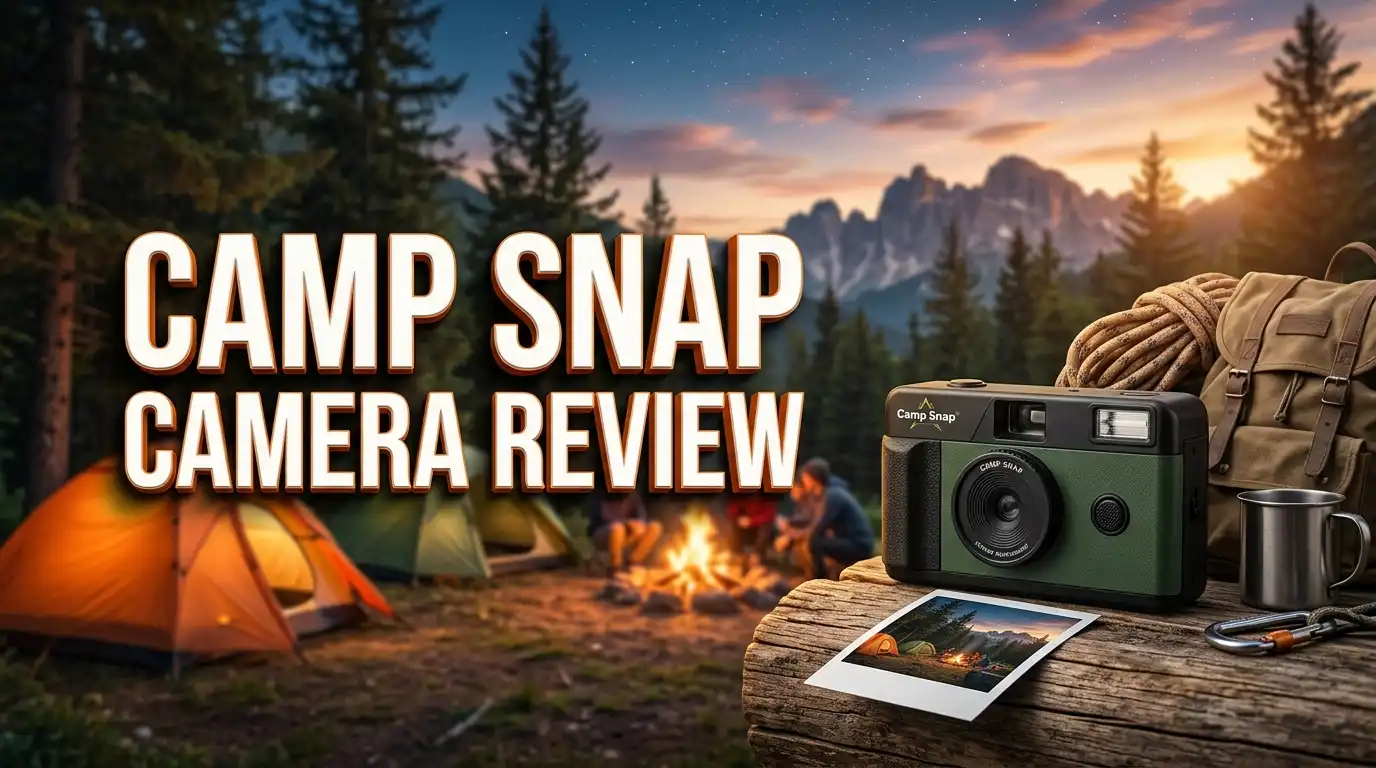
Camp Snap Camera Review 2026: Screen Free Digital Camera?
Are you tired of pulling out your phone for every photo and then falling into a social media scroll? The Camp Snap camera offers a refreshing break from screen addiction. This tiny, screen free digital camera has taken the photography world by storm. It gives you the joy of a disposable film camera without the waste or recurring film costs.
The Camp Snap camera is simple. It has one button, no LCD screen, and a vintage look that fits in your pocket. Kids love it for summer camp. Adults love it for travel, hiking, and everyday life. But is it really worth the price? Does the photo quality hold up? And how does the newest V105 version compare?
In this Camp Snap camera review for 2026, we break down everything you need to know. We cover the specs, the photo quality, the battery life, the custom filters, and the pros and cons. We also compare it to the Camp Snap Pro and three solid alternatives. Read on to find out if this little camera belongs in your pocket.

Key Takeaways
- The Camp Snap camera is a screen free digital camera that costs around $70. It works like a disposable camera but stores up to 2,000 photos on a 4GB microSD card. You can reuse it again and again without buying film.
- The 8MP sensor and F1.8 lens deliver a nostalgic, film like photo quality. Images look warm and slightly soft. They will not match your smartphone, but that is the point. The charm is in the imperfection.
- Battery life is impressive at 500 photos per charge. The built in lithium ion battery charges through USB C in about 1 to 1.5 hours. You will rarely worry about running out of power during a day of shooting.
- Custom filters are now supported on the V105 model. You can create your own filters or download community made ones from CampShades.com. This adds a fun layer of creativity to an already playful camera.
- The Camp Snap Pro ($99) is a step up with a 16MP sensor, f/2.2 lens, and a 37mm filter thread. It offers better image quality for adults who want more from their screen free shooting experience.
- This camera is ideal for kids at summer camp, travelers, hikers, and anyone who wants a digital detox. It is not a replacement for a professional camera. It is a fun, intentional way to capture memories.
What Is the Camp Snap Camera?

- Minimalist & robust design
Last update on 2026-08-27 / Affiliate links / Images from Amazon Product Advertising API
The Camp Snap camera is a screen free, point and shoot digital camera. It was originally created for kids heading to summer camps that ban electronic devices with screens. The camera has no LCD display on the back. You simply point, shoot, and move on with your day.
The concept is straightforward. Camp Snap removes the distraction of reviewing every photo instantly. You shoot your pictures and then transfer them to a computer later using a USB C cable. This approach encourages a more present and mindful style of photography.
The camera looks like a classic disposable film camera. It measures about 4.5 inches long, 2.5 inches tall, and 1 inch deep. It weighs just 93 grams. You can clip it to a bag, toss it in a pocket, or hand it to a child without worry.
Camp Snap has grown far beyond its summer camp roots. Adults now use it for street photography, travel, hiking, and everyday snapshots. The brand has expanded its lineup with the Camp Snap Pro and the CS 8 video camera. But the original remains the most popular model for good reason.
Camp Snap Camera Design and Build Quality
The Camp Snap has a retro, boxy design that recalls the disposable cameras of the 1990s. It comes in several colors, including brown and green. The body is made of lightweight plastic, but it feels solid enough for daily use.
The top of the camera has a simple shutter button and a power switch. There is a small LCD panel on the back that shows the photo count and battery status. This is the only screen on the entire camera. It does not display images.
The optical viewfinder sits at the top right corner. You look through it to frame your shot. This is a basic window viewfinder, so what you see is roughly what you get. It does not show exact framing.
Durability is a strong point. Many parents report that their kids have taken the Camp Snap on hiking trips, camping adventures, and beach vacations without any damage. The camera is not waterproof, but Camp Snap sells a waterproof case separately. For its price and target audience, the build quality is more than acceptable.
Camp Snap Camera Specifications
The Camp Snap V105 is the latest standard model. It packs an 8MP CMOS sensor in a 1/3.2 inch format. The fixed focus lens has an f/1.8 aperture and a 35mm equivalent focal length. This wide angle perspective works well for landscapes and group photos.
The camera stores images on a pre installed 4GB microSD card. This card can hold up to 2,000 photos. You can also swap the card for a larger one if needed. Images save as JPEG files.
White balance is automatic. There are no manual settings for exposure, ISO, or shutter speed. The camera handles everything on its own. It also has a built in LED flash that fires automatically in low light.
Charging happens through a USB C port on the side. The internal lithium ion battery lasts for about 500 photos per charge. A full charge takes approximately 1 to 1.5 hours. There is also a small speaker that plays a shutter sound effect for a satisfying click with each photo.
Top 3 Alternatives for Camp Snap Camera
If the Camp Snap is not quite what you need, here are three popular alternatives worth checking out.
1. Paper Shoot Camera

Last update on 2026-08-27 / Affiliate links / Images from Amazon Product Advertising API
The Paper Shoot Camera is an 18MP screen free digital camera with an eco friendly design. Its body is made from durable paper material. It offers four built in filters, 10 second video, and timelapse mode. It is a strong choice for anyone who wants a creative, minimalist camera with slightly higher resolution than the Camp Snap.
2. Fujifilm Instax Mini 12

- Compact and cute design. Easily twist the lens to turn on and off
- Built-in selfie mirror for easy selfies Close-up mode with parallax correction
- Features automatic exposure and flash control for bright photos that are not “washed-out”
Last update on 2026-08-27 / Affiliate links / Images from Amazon Product Advertising API
The Fujifilm Instax Mini 12 is an instant print camera that produces physical photos on the spot. It is a different experience from the Camp Snap. Instead of storing digital files, it prints credit card sized photos immediately. This camera is perfect for parties, events, and anyone who loves tangible keepsakes.
3. Kodak Mini Shot 3 Retro

- 2-in-1 Instant Camera & Printer: The KODAK Mini Shot 3 Retro combines an instant camera and portable photo printer...
- Using genuine 4PASS dye sublimation printing, each photo is produced in three color layers and finished with a...
- Easy to use: Take photos and print them instantly with straightforward controls and minimal setup. Power on...
Last update on 2026-08-27 / Affiliate links / Images from Amazon Product Advertising API
The Kodak Mini Shot 3 Retro is a 2 in 1 instant camera and photo printer. It combines digital photography with instant prints. It connects to your smartphone through Bluetooth and uses 4PASS printing technology. It is a solid pick if you want both digital copies and physical prints from the same device.
Camp Snap Photo Quality: What to Expect
Photo quality is the most debated topic among Camp Snap users. The 8MP sensor produces images that are warm, slightly soft, and full of character. Photos look like they came from a film camera, not a modern smartphone.
In bright sunlight, the Camp Snap performs best. Colors appear vivid. Details are clear enough for social media posts and small prints. Outdoor daylight shots have a pleasant, nostalgic quality that many users genuinely love.
Indoor and low light photos are a different story. The camera tends to overexpose bright areas and use slow shutter speeds. This can lead to blurry images in dim settings. The LED flash helps, but its range is limited.
The fixed focus lens means everything beyond a certain distance stays in focus. Close up subjects within a few feet may appear soft or blurry. This is a point and shoot camera in the truest sense. You frame your subject, press the button, and accept the result.
If you expect smartphone level sharpness, you will be disappointed. But if you appreciate the unpredictable, artistic look of film photography, the Camp Snap delivers a unique aesthetic that many photographers find addictive.
Custom Filters and CampShades
One of the best features of the Camp Snap V105 is custom filter support. Camp Snap launched a website called CampShades.com where users can create their own filters or download community made ones.
The process is simple. You connect your Camp Snap to a computer with a USB C cable. You download a filter file (.flt format) from CampShades. Then you drag and drop the file onto the camera’s storage. The next time you shoot, the camera applies that filter to every image.
Popular filters include warm vintage tones, cool blue casts, high contrast black and white, and classic Kodak style color profiles. The community creates new filters regularly. This gives the Camp Snap a level of customization that no disposable camera can match.
The V105 model ships with the latest firmware that supports filters right out of the box. Older models (like the V103B) require a firmware update to access this feature. The update process is easy and only takes a few minutes.
Filters change the entire shooting experience. A single camera can produce vastly different photo styles depending on which filter you load. This keeps the Camp Snap fresh and fun over time.
Battery Life and Charging
The Camp Snap camera has a built in lithium ion rechargeable battery. Camp Snap rates it for 500 photos on a full charge. In real world use, most reviewers confirm this estimate is accurate.
Charging is quick. Plug the camera into any USB C cable, and it reaches full charge in about 1 to 1.5 hours. A small LED indicator on the camera shows charging status. The back panel LCD also displays remaining battery level.
For a typical day of shooting, battery life is never an issue. Even heavy users report getting through several hundred photos before needing a charge. If you shoot casually during a vacation or camping trip, the battery can last several days.
One important note: if the battery dies completely, the camera shuts off. Your photos remain safe on the microSD card. You simply recharge and continue shooting or transfer your images to a computer. There is no risk of losing saved photos due to a dead battery.
Camp Snap vs Camp Snap Pro
- Minimalist & robust design
Last update on 2026-08-27 / Affiliate links / Images from Amazon Product Advertising API
Camp Snap now offers two main camera models. The standard Camp Snap V105 costs around $70. The Camp Snap Pro (CS Pro) costs $99. Both are screen free point and shoot cameras, but they differ in several important ways.
The Camp Snap Pro upgrades the sensor to 16MP with a 1/3.06 inch CMOS chip. This produces sharper images with more detail. The lens shifts to an f/2.2 aperture with a 22.5mm equivalent focal length. That wider angle is great for landscapes and group shots.
A major addition on the Pro is the 37mm filter thread. This lets you attach physical lens filters for creative effects. The Pro also has a xenon flash instead of an LED flash. Xenon produces a brighter, more powerful burst of light that works much better in dark conditions.
The Pro supports up to four customizable film style filter profiles at once. You can switch between them without connecting to a computer. The standard Camp Snap only holds one filter at a time.
If you want better image quality and more creative options, the Pro is worth the extra $30. If you want the simplest possible experience at the lowest price, the standard V105 does the job well.
Who Should Buy the Camp Snap Camera?
The Camp Snap is perfect for a specific type of user. Kids heading to summer camp are the obvious audience. Many camps prohibit smartphones and tablets. The Camp Snap follows camp rules because it has no screen and no internet connection.
Travelers and backpackers benefit from its small size and light weight. You can toss it in a bag without adding bulk. It captures memories without the temptation to scroll through social media between shots.
Hikers, bikers, and outdoor adventurers appreciate the simplicity. There are no settings to adjust, no menus to navigate. You just point and shoot. This speed matters during fast moving activities.
Photography enthusiasts who love the look of film will enjoy the Camp Snap’s aesthetic. The custom filters add creative depth. Many serious photographers carry a Camp Snap alongside their main camera as a fun, low pressure creative tool.
People who want a digital detox from their phones are another ideal audience. The Camp Snap forces you to be present. You take your photo and keep living your life. There is no review screen to pull you out of the moment.
How to Transfer Photos from Camp Snap
Transferring photos from the Camp Snap camera is a simple process. You connect the camera to your computer using the included USB C cable. The camera appears as a removable storage device, just like a flash drive.
Open the camera’s folder on your computer. You will find all your JPEG images stored in a standard folder structure. Simply drag and drop them to your desktop, external drive, or cloud storage. The entire process takes less than a minute for a few hundred photos.
You can also remove the 4GB microSD card from the camera and insert it into a card reader. This method works well if you want to free up space on the camera quickly. Some users keep multiple microSD cards and swap them out during long trips.
For mobile phone transfers, some Camp Snap models support OTG (On The Go) connections. You plug the USB C cable from the camera into your phone with an adapter. Your phone reads the camera’s storage directly. This is useful if you want to post photos to social media while traveling.
After transferring your photos, you can delete the files from the camera to free up space. The 4GB card holds approximately 2,000 photos, so most users will not need to transfer mid trip.
Camp Snap Camera for Kids: A Parent’s Perspective
Parents love the Camp Snap for several clear reasons. The screen free design means kids cannot browse the internet, play games, or get distracted by apps. They only have one function available: take photos.
The camera is lightweight at just 93 grams. Small hands can hold it without strain. The single button operation means kids as young as five or six can use it independently. There is nothing to configure or adjust.
Summer camp compatibility is a huge selling point. Many camps ban all electronic devices with screens. The Camp Snap passes this rule because it has no viewing screen. Kids can document their camp experience and share the photos with parents after pickup.
The rechargeable battery eliminates the need for disposable batteries. Parents do not need to buy film rolls either. The reusable nature of the camera makes it far more cost effective than giving a child a disposable camera for every event.
Durability is solid for the price point. Several parent reviewers report that their children have used Camp Snap cameras for over a year with no issues. The cameras survive drops, stuffed backpacks, and rough outdoor play. They are not indestructible, but they hold up well for a $70 device.
Camp Snap Camera Pros and Cons
Pros:
- Screen free design keeps you present and mindful
- Lightweight and compact at just 93 grams
- Rechargeable USB C battery lasts 500 photos per charge
- Custom filter support adds creative variety
- 4GB microSD card included stores up to 2,000 photos
- Affordable price at around $70
- Reusable and eco friendly compared to disposable film cameras
Cons:
- Image quality is limited compared to smartphones
- No manual controls for exposure or focus
- Low light performance is weak with frequent overexposure
- LED flash has short range and limited power
- No video recording on the standard model
- Fixed focus lens struggles with close up subjects
The Camp Snap delivers exactly what it promises. It is a fun, simple, screen free camera with a film like aesthetic. The cons exist because this is a $70 toy camera at heart. Set your expectations accordingly, and you will enjoy it.
Is the Camp Snap Camera Worth It in 2026?
The Camp Snap camera remains a strong buy in 2026. The competition has grown. Cameras like the Flashback ONE35 V2, Paper Shoot, and various screenless alternatives have entered the market. But Camp Snap still holds its position as the most recognized and accessible option.
At $70 for the standard model and $99 for the Pro, the pricing is fair. A single use disposable film camera costs $15 to $20 and gives you only 27 shots. The Camp Snap pays for itself after a few uses.
The custom filter ecosystem adds ongoing value. The CampShades community continues to grow, and new filter options appear regularly. This keeps the camera feeling fresh months and years after purchase.
For its intended purpose, the Camp Snap is absolutely worth the money. It captures fun, nostalgic, screen free memories without the waste of film or the distraction of a smartphone screen. If that sounds like what you want, you will not regret this purchase.
Final Verdict on the Camp Snap Camera
The Camp Snap camera is a delightful, purpose built digital camera that does one thing and does it well. It captures photos with a charming film aesthetic in the simplest possible way. No screen. No settings. Just point and shoot.
The standard V105 model is best for kids, casual users, and digital detox seekers. The Camp Snap Pro is ideal for photography enthusiasts who want better resolution, a xenon flash, and lens filter support.
Photo quality will not win awards. Low light shots are often hit or miss. But the joy and intentionality this camera brings to photography is hard to put a price on.
If you value simplicity, nostalgia, and being present in the moment, the Camp Snap camera earns a strong recommendation in 2026.
Frequently Asked Questions
How many photos can the Camp Snap camera hold?
The Camp Snap camera comes with a 4GB microSD card that stores up to 2,000 photos. You can also replace the card with a larger one if you need more space. Most users find 2,000 photos more than enough for vacations, summer camps, and everyday shooting.
Is the Camp Snap camera waterproof?
No, the Camp Snap camera is not waterproof on its own. However, Camp Snap sells a separate waterproof case that protects the camera from water damage. This case is a good investment if you plan to use the camera at the beach, pool, or during rainy outdoor activities.
How do you charge the Camp Snap camera?
The Camp Snap charges through a USB C port on the side of the camera. You can use any standard USB C cable and plug it into a wall adapter, power bank, or computer. A full charge takes about 1 to 1.5 hours and lasts for roughly 500 photos.
Can you add filters to the Camp Snap camera?
Yes, the V105 model supports custom filters. You can create your own filters or download community made ones from CampShades.com. You load the filter file onto the camera via USB C, and it applies to all future photos until you change it.
What is the difference between Camp Snap and Camp Snap Pro?
The standard Camp Snap has an 8MP sensor, f/1.8 lens, and LED flash at $70. The Camp Snap Pro has a 16MP sensor, f/2.2 lens, xenon flash, and 37mm filter thread at $99. The Pro also supports up to four switchable filter profiles. The Pro delivers better image quality and more creative options for a slightly higher price.
Is the Camp Snap camera good for adults?
Absolutely. While Camp Snap was originally created for kids at summer camp, many adults now use it daily. Travelers, hikers, street photographers, and anyone who wants a break from their smartphone screen finds value in this camera. The custom filter support and film like aesthetic appeal to photographers of all ages.

Meet Amelia, the adventurous soul behind TravelersEnthusiasm.com. With a heart set on exploration, she crafts tales that whisk readers from European alleys to Asian landscapes. Amelia‘s stories are genuine, reflecting her deep connections and reverence for diverse cultures. When not traveling, she’s sketching in cafes or exchanging tales with fellow wanderers.
