
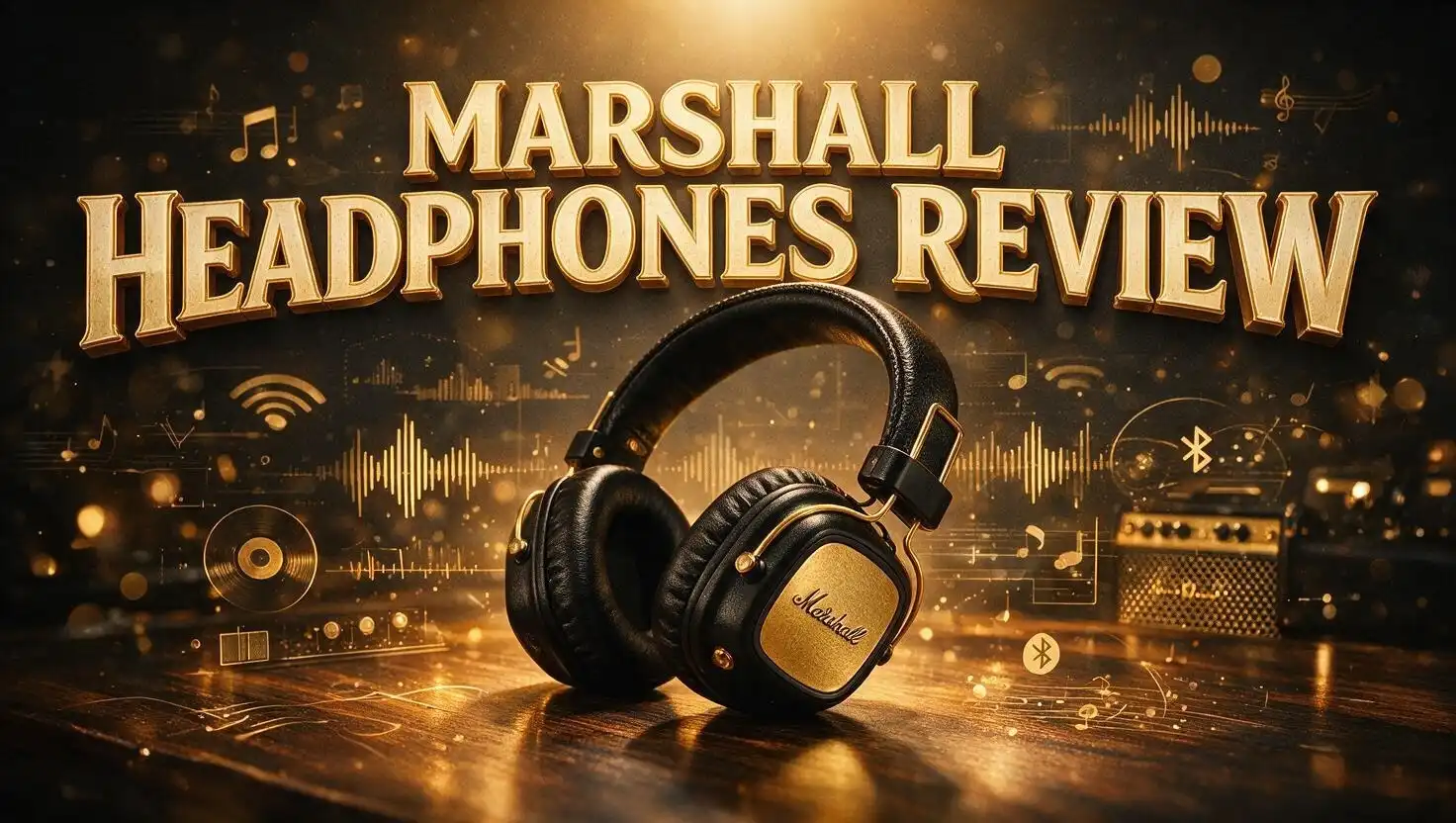
Marshall Headphones Review 2026: Is It Still Worth Buying?
Marshall built its name on guitar amps that shaped rock music. Today the same logo sits on some of the most recognisable headphones you can buy.
But looks alone do not justify a purchase. You want to know how they sound, how long they last, and whether they beat Sony or Bose at the same price.
I spent time with the main models in the current lineup. This review covers the good, the average, and the parts Marshall still needs to fix.
By the end you will know exactly which Marshall model fits your ears, your budget, and your music.
In a Nutshell
Here is the short version for readers who want answers fast.
- Marshall Major V is the value champion. It offers more than 100 hours of playtime for around $149. The on ear fit stays light at 186 grams. There is no active noise cancelling, but wireless charging and a folding frame make it a brilliant daily commuter pick.
- Marshall Monitor III ANC is the flagship. You get 70 hours of playtime with ANC switched on and 100 hours with it off. Bluetooth 5.3, spatial audio, and 32 mm drivers put it in direct competition with Sony and Bose, and it undercuts both on price.
- Marshall Motif II ANC handles the earbud side. Punchy bass, secure fit, wireless charging, and around 30 hours of total playtime with the case. Codec support stays basic at SBC and AAC.
- The Marshall sound signature is warm and bass forward. It flatters rock, hip hop, and electronic music. Purists who want flat studio accuracy should look elsewhere.
- Battery life is the real headline. No mainstream brand comes close to what Marshall offers per charge. You can go weeks between top ups.
- Build quality feels premium. Textured vinyl finish, brass details, and the classic script logo give these headphones a personality that plain black plastic rivals lack.
Why Marshall Headphones Feel Different
Most headphone brands chase the same look. Smooth plastic, muted grey, invisible branding. Marshall goes the opposite direction.
The textured vinyl wrap copies the finish of a real amp cabinet. The gold script logo sits proudly on the headband. People notice these headphones.
The design is not just decoration. That textured surface resists fingerprints far better than the glossy plastic used by many rivals.
Marshall also keeps physical controls. Every model in the lineup uses a small brass coloured joystick called the M button.
You push it up for volume, left and right for tracks, and press it to play or pause. This single control replaces the fussy touch panels found on most competitors.
I found the joystick easier to use with gloves, in the rain, and while walking. Touch controls misfire. This does not.
Marshall partners with Zound Industries for its audio products. The engineering happens in Sweden, while the branding stays true to the British amp heritage.
Some audiophiles dismiss the brand for this reason. That criticism misses the point.
Marshall is not trying to build reference monitors. It builds headphones for people who want their music loud, warm, and fun.
The tuning reflects that goal. Bass hits hard, mids stay smooth, and treble adds sparkle without turning harsh.
If you listen to rock, metal, hip hop, or electronic music, this approach works in your favour every single time.
Marshall Major V Review

- MARSHALL SIGNATURE SOUND: Experience powerful bass, smooth mids and crisp treble that are expertly balanced.
- 100+ HOURS OF WIRELESS PLAYTIME: Listen to your favourite music for days without needing to charge.
- RUGGED AND FOLDABLE DESIGN: Major V is built to last and to be easily packed away with you wherever you go.

Last update on 2026-07-31 / Affiliate links / Images from Amazon Product Advertising API
The Major V is the model most people should buy first. It costs around $149 and delivers more than 100 hours of wireless playtime.
That number sounds like marketing. In real testing at moderate volume, the figure holds up well.
I charged mine once and used them daily for three weeks. That kind of endurance changes how you use headphones.
Weight sits at just 186 grams. The on ear cups press lightly rather than clamping down.
I wear glasses and still managed four hour sessions without pain. That is rare for an on ear design.
Sound leans warm. Bass carries real weight, mids stay clear, and vocals sit forward in the mix.
The Major V adds wireless charging, which is unusual at this price. Drop it on any Qi pad and it fills back up.
A 15 minute quick charge gives you around 15 hours of listening. That covers a forgotten charge before a flight.
Bluetooth 5.3 with multipoint lets you connect a laptop and a phone at the same time. Switching happens automatically.
The frame folds flat for storage. A detachable 3.5 mm cable lets you go wired when the battery finally dies.
There is no active noise cancelling here. Passive isolation blocks some office chatter but will not silence an engine drone.
Pros
- Over 100 hours of real world battery life
- Very light at 186 grams
- Wireless charging included at this price
- Physical M button beats touch controls
- Folding design and detachable cable
Cons
- No active noise cancelling
- On ear fit isolates less than over ear rivals
- Only SBC and AAC codec support
Marshall Monitor III ANC Review

- 70 HOURS OF WIRELESS PLAYTIME WITH ACTIVE NOISE CANCELLATION: 70 hours of wireless playtime with active noise...
- ACTIVE NOISE CANCELLING & TRANSPARENCY MODE: Monitor III A.N.C.’s active noise cancellation has been...
- MARSHALL SIGNATURE SOUND: Sensational sound guarantee. Featuring Dynamic Loudness, these headphones adjust the...
Last update on 2026-07-31 / Affiliate links / Images from Amazon Product Advertising API
The Monitor III ANC is the flagship. It is the model that competes directly with the Sony and Bose flagships.
Battery life again leads the class. You get 70 hours with noise cancelling active and around 100 hours without it.
Sony and Bose offer roughly 24 to 30 hours. Marshall triples that figure.
A 15 minute charge returns about 12 hours of playtime. Full charging takes around 2.5 hours.
The 32 mm dynamic drivers produce a big, room filling sound. Bass digs deep without smothering the midrange.
Vocals sound natural here in a way the cheaper models cannot match. Acoustic tracks and live recordings especially benefit.
Noise cancelling performance is good rather than class leading. It removes low rumble from planes, trains, and air conditioning well.
Higher pitched sounds like voices still leak through more than they do on a Bose QuietComfort Ultra. For most commuters this remains perfectly acceptable.
Comfort is a strong point. The over ear cups use soft memory foam and the headband spreads weight evenly.
Spatial audio with head tracking is included. I found it fun for films and less useful for music.
The Marshall Bluetooth app offers a five band equaliser and preset modes. Adjustments save directly to the headphones.
Codec support stops at SBC and AAC. There is no LDAC or aptX, which will disappoint Android listeners who stream high resolution files.
Pros
- 70 hours of playtime with ANC on
- Excellent comfort for long journeys
- Rich, warm sound with strong bass control
- Wired and wireless listening options
- Costs less than Sony and Bose flagships
Cons
- ANC trails Bose and Sony slightly
- No LDAC or aptX support
- Spatial audio adds little for music
Marshall Motif II ANC Review

- MARSHALL SIGNATURE SOUND. Precision engineered to give you clear and balanced sound no matter how much you crank up...
- CANCEL THE NOISE, AMPLIFY THE SOUND. Improved active noise cancellation and use the app to amplify your playlist...
- RELIABLE PLAYTIME. Delivers 10 more hours of playtime than its predecessor. With active noise cancellation and the...
Last update on 2026-09-30 / Affiliate links / Images from Amazon Product Advertising API
The Motif II ANC covers the true wireless earbud side of the lineup. It carries the same amp inspired styling in a much smaller package.
The charging case copies the texture of a Marshall cabinet. It slips into a jeans pocket easily.
Total playtime reaches around 30 hours with the case. The buds themselves last roughly six hours with ANC active.
Sound is unashamedly punchy. Bass leads the presentation and drives rhythm tracks hard.
Hip hop, house, and rock all benefit from this tuning. Classical listeners may want to dial the bass back in the app.
Noise cancelling works well for the size. It handles bus engines and office hum with confidence.
Fit is secure thanks to the compact shape and included ear tip sizes. I ran with these and they stayed put.
Wireless charging comes built into the case. Multipoint pairing lets you juggle two devices without menus.
Call quality holds up in quiet rooms. Wind noise still causes trouble outdoors.
The Motif II ANC is the best choice if you want Marshall style without the bulk of over ear cups.
Codec support again stays at SBC and AAC. This is the one area where Marshall consistently lags behind.
Pros
- Punchy, energetic bass response
- Solid active noise cancelling for the size
- Secure fit for workouts and travel
- Wireless charging case with Marshall styling
- Reliable multipoint pairing
Cons
- Around six hours per charge with ANC on
- Basic codec support
- Wind noise affects outdoor calls
Top 3 Alternatives for Marshall Monitor III ANC
If the Monitor III ANC does not quite fit your needs, these three models deserve a look.

- THE BEST NOISE CANCELLATION: Powered by advanced processors and an adaptive microphone system, the WH-1000XM...
- CO-CREATED WITH MASTERING AUDIO ENGINEERS: Developed in collaboration with world-renowned mastering audio...
- HD NOISE CANCELING PROCESSOR QN3: The HD Noise Canceling Processor QN3 is 7x faster than the QN1 (found in our...
Last update on 2026-06-07 / Affiliate links / Images from Amazon Product Advertising API

- SPATIAL AUDIO HEADPHONES: Bose QuietComfort Ultra Headphones with spatial audio give you an immersive experience...
- NOISE CANCELING HEADPHONES: These wireless noise cancelling headphones feature Quiet Mode, Aware Mode and Immersion...
- HEADPHONES WITH MIC: Microphones focus on the sound of your voice and the bluetooth headphones with microphone...
Last update on 2026-07-31 / Affiliate links / Images from Amazon Product Advertising API

- Seamless Firmware & App Updates: Enjoy a smoother, more reliable experience with the latest firmware and Smart...
- Audiophile-Inspired Sound : Sennheiser wireless headphones over ear with Signature Sound, 42mm transducers and aptX...
- Personalized Listening Experience: Tailor your sound on the over ear headphones wireless via the Smart Control Plus...
Last update on 2026-07-31 / Affiliate links / Images from Amazon Product Advertising API
The Sony WH-1000XM6 sits at the top of the noise cancelling market. Its ANC removes more mid range noise than anything Marshall offers.
Sony also supports LDAC for high resolution streaming. Battery life drops to around 30 hours, which feels short after using a Marshall.
The Bose QuietComfort Ultra delivers the quietest listening experience available today. Its immersive audio mode creates a wide, speaker like stage.
Bose comfort is exceptional for long flights. You pay a premium for that silence, and battery life sits near 24 hours.
The Sennheiser Momentum 4 offers the most neutral sound of the three. Detail retrieval beats Marshall clearly.
It also runs for around 60 hours per charge, making it the closest rival on endurance. Its plain design lacks the character that draws people to Marshall in the first place.
Choose Sony for the best noise cancelling, Bose for comfort and silence, and Sennheiser for balanced sound. Choose Marshall when battery life, style, and warm bass matter most to you.
Marshall Minor IV Review

- MARSHALL SIGNATURE SOUND: Hit play and you'll unleash an expertly balanced sound that commands attention.
- 30+ HOURS OF WIRELESS PLAYTIME: Don’t get stranded without music when you need it most. Minor IV packs 30+ hours...
- RE-DESIGNED FOR SUPERIOR COMFORT: When you’re listening to music, one track is never enough, so the Minor IV...
Last update on 2026-07-31 / Affiliate links / Images from Amazon Product Advertising API
The Minor IV takes a different path. These are open fit earbuds with no silicone tips at all.
They rest in your ear rather than sealing inside it. If you dislike the plugged up feeling of standard earbuds, this design solves that problem.
Playtime reaches around 30 hours with the charging case included. The buds run for roughly five hours alone.
Because there is no seal, there is no noise cancelling. You hear everything around you.
That is a feature, not a flaw, for cyclists, runners, and office workers who need situational awareness.
Sound is lighter than the Motif II ANC. Bass still exists but lacks the same punch.
Vocals and guitars come through cleanly. Podcasts sound excellent through this open design.
Comfort is the strongest selling point. I forgot I was wearing them after 20 minutes.
The case feels lighter and more plastic than the Motif case. Some owners find it slightly flimsy.
Price sits around $129, which places it against the standard AirPods. The Minor IV wins on battery life and loses on ecosystem features.
Pros
- Comfortable open fit with no ear pressure
- Full awareness of your surroundings
- Around 30 hours of total playtime
- Distinctive Marshall styling
- Good clarity for voices and podcasts
Cons
- No noise isolation whatsoever
- Bass response is modest
- Case feels less premium than the buds
The Marshall Sound Signature Explained
Every brand tunes its headphones differently. Marshall follows a consistent house sound across the range.
Bass sits elevated above neutral. Sub bass rumble comes through clearly on electronic tracks.
Mids stay slightly warm. Guitars gain body and vocals sound full rather than thin.
Treble adds enough sparkle for cymbals and strings. Marshall avoids the sharp peaks that cause listening fatigue.
This tuning suits rock, metal, blues, hip hop, and electronic music perfectly. Those genres make up the bulk of what most buyers actually play.
Classical and jazz listeners will notice the bass lift. It can slightly mask fine detail in orchestral recordings.
The Marshall Bluetooth app fixes much of this. A five band equaliser lets you reduce bass and lift the upper mids.
Preset modes cover rock, pop, and voice content. Changes apply immediately and save to the headphones themselves.
No Marshall model is a reference tool. They are not built to reveal every flaw in a recording.
They are built to make music enjoyable during a commute, a workout, or a long flight. Judged by that standard, they succeed.
Battery Life That Outlasts Everything Else
Battery life is where Marshall genuinely beats every mainstream competitor. The numbers are not close.
The Major V claims over 100 hours. The Monitor III ANC claims 70 hours with ANC active and 100 hours without.
Sony and Bose flagships offer 24 to 30 hours. Sennheiser reaches 60 hours with the Momentum 4.
In practice, endurance changes your habits. You stop thinking about charging entirely.
I charged the Major V once and used it for daily commuting across three weeks. The battery still had capacity left.
Quick charging supports the same convenience. Fifteen minutes gives you 12 to 15 hours depending on the model.
The Major V and Monitor III ANC both include a battery preservation feature. It caps charging at 90 percent and manages temperature.
This protects long term battery health. Most headphones ignore this entirely.
Earbuds cannot match over ear endurance because of physical size limits. The Motif II ANC and Minor IV both land near 30 hours total.
If you travel often or simply hate charging cables, Marshall gives you the least stressful option available.
Comfort and Fit for Long Sessions
Comfort depends heavily on which model you choose. The lineup covers three different fit styles.
The Major V uses an on ear design. Pads rest on your ears rather than surrounding them.
Clamping force stays light. At 186 grams, pressure spreads gently across the head.
I managed four hour sessions comfortably with glasses on. Some listeners with larger ears still prefer over ear cups for all day wear.
The Monitor III ANC uses full over ear cups. Memory foam pads surround the ear completely.
The headband distributes weight well. Long flights pose no problem here.
Heat build up is minimal thanks to the soft pad material. This matters during summer travel.
The Motif II ANC sits inside the ear canal with a silicone tip. Three tip sizes come in the box.
Fit stays secure during exercise. The compact shell avoids the pressure some larger earbuds create.
The Minor IV skips the seal completely. It rests in the outer ear like a standard AirPod.
Comfort is excellent, but the trade off is zero isolation. Choose based on where and how you listen.
Build Quality and Retro Design
Marshall headphones feel solid in the hand. The materials go beyond what most brands offer at similar prices.
The textured vinyl finish mimics a real amplifier cabinet. It hides fingerprints and resists scuffs well.
Brass coloured details sit on the hinges and control joystick. These small touches lift the whole product.
The script logo remains one of the most recognisable marks in music. It signals taste rather than just brand loyalty.
Hinges on the Major V and Monitor III ANC fold smoothly. They feel firm rather than loose after months of use.
Marshall has also improved repairability across recent models. Ear cushions detach and replace easily on the Monitor III ANC.
The company now offers replacement parts for several components. Very few headphone brands support this.
Recent models use recycled plastics in the construction. Marshall states that the Monitor III ANC contains a significant percentage of recycled material.
Charging happens over USB C on every current model. The Major V and Motif II ANC add wireless charging.
Water resistance is limited. None of the over ear models carry an official IP rating, so avoid heavy rain.
Noise Cancelling and Call Performance
Two Marshall models offer active noise cancelling. The Monitor III ANC and the Motif II ANC.
Monitor III ANC performance is good. It removes engine drone, train rumble, and air conditioning hum effectively.
Human voices still leak through more than they do on Bose or Sony flagships. Marshall trades a little silence for a lot of battery life.
For most commuters, that trade makes sense. You still get meaningful quiet on a plane or a bus.
Transparency mode works cleanly. It sounds natural rather than hissy, which is a genuine strength.
Adaptive volume adjusts output based on surrounding noise. I preferred switching this off for consistent listening.
Call quality on the Monitor III ANC is solid indoors. Callers reported clear voice pickup during video meetings.
Outdoor calls suffer in wind. The microphones struggle to separate speech from gusts.
The Motif II ANC performs similarly. Quiet environments produce clear calls, while windy streets cause problems.
The Major V has no ANC at all. Passive isolation from the on ear pads blocks moderate office noise only.
If silence is your top priority, the Monitor III ANC is the only Marshall worth considering.
Price and Value for Money
Marshall pricing lands in a smart position. It sits below the flagship tier while offering premium construction.
The Major V costs around $149 at retail. Discounts frequently push it closer to $100.
At that price it competes with mid range models from Sony and JBL. Battery life and build quality make it a clear winner in that bracket.
The Monitor III ANC launched near $349 and regularly sells lower. Sales have pushed it below $250.
Compare that to $400 or more for the Sony and Bose flagships. You give up some ANC performance and gain enormous battery life.
The Motif II ANC sits near $199. It competes with AirPods Pro and the Sony mid range earbuds.
The Minor IV costs around $129. That places it against standard AirPods and open fit rivals.
Marshall runs frequent promotions. Checking prices before buying often saves 20 to 30 percent.
Value depends on what you prioritise. Buy Marshall for battery life, design, and warm sound.
Buy elsewhere if you need class leading noise cancelling or high resolution codec support.
Who Should Buy Marshall Headphones
Marshall headphones suit specific listeners very well. They frustrate others just as clearly.
You should buy them if you love rock, metal, hip hop, or electronic music. The tuning was made for those genres.
You should buy them if you hate charging. No competitor comes close on endurance.
You should buy them if design matters to you. These headphones look better than almost anything else on the market.
You should buy them if you prefer physical buttons. The M button joystick is genuinely better than touch panels.
You should look elsewhere if you need the absolute best noise cancelling. Bose and Sony still lead there.
You should look elsewhere if you stream high resolution audio on Android. The lack of LDAC and aptX limits quality.
You should look elsewhere if you want flat, neutral studio sound. Marshall tuning adds warmth by design.
Most casual and enthusiast listeners will be very happy here. Only strict audiophiles and frequent flyers seeking total silence should hesitate.
Final Verdict
Marshall makes headphones with a clear identity. That confidence shows in every product decision.
The Major V is the smartest buy in the lineup. It offers extraordinary battery life, light comfort, and wireless charging for around $149.
The Monitor III ANC is the model to choose when you want noise cancelling and over ear comfort. Seventy hours of ANC playtime remains unmatched.
The Motif II ANC delivers punchy sound in a pocket sized package. It suits commuters and gym users equally.
The Minor IV serves a smaller audience. Open fit comfort and awareness make it ideal for runners and office workers.
None of these models win on pure technical measurement. Sony offers better ANC and Sennheiser offers better detail.
Marshall wins on the things people actually use daily. Battery life, control simplicity, build quality, and character.
I finished testing with a simple conclusion. These are headphones you enjoy rather than analyse.
If that matches how you listen to music, Marshall deserves your money. Check current prices before you buy, because discounts appear often.
Frequently Asked Questions
Are Marshall headphones good quality?
Yes. Build quality is strong across the lineup, with textured vinyl finishes, brass details, and firm hinges. Sound quality favours warm bass over strict neutrality, which suits most popular music genres well.
Which Marshall headphone has the best battery life?
The Major V leads with over 100 hours of wireless playtime. The Monitor III ANC offers 70 hours with noise cancelling active and around 100 hours with it switched off.
Do Marshall headphones have noise cancelling?
Two models do. The Monitor III ANC and the Motif II ANC both include active noise cancelling. The Major V and Minor IV rely on passive isolation only.
Are Marshall headphones good for gaming?
They work for casual gaming. Bluetooth latency is acceptable for most titles, and wired mode through the 3.5 mm cable removes lag entirely on the over ear models. Competitive gamers should choose a dedicated gaming headset.
Do Marshall headphones support LDAC or aptX?
No. Current models support SBC and AAC only. Android users who stream high resolution files may prefer Sony or Sennheiser alternatives.
Is the Marshall Major V better than the Major IV?
Yes. The Major V improves battery life from 80 to over 100 hours, reduces weight, adds Bluetooth 5.3 with multipoint, and includes a battery preservation feature.
Can you use Marshall headphones while charging?
Yes on the over ear models. You can listen through the 3.5 mm cable while the USB C port charges the battery.
How long do Marshall headphones last?
With normal care, most owners report three to five years of reliable use. Replaceable ear cushions and available spare parts extend that lifespan further.

Meet Amelia, the adventurous soul behind TravelersEnthusiasm.com. With a heart set on exploration, she crafts tales that whisk readers from European alleys to Asian landscapes. Amelia‘s stories are genuine, reflecting her deep connections and reverence for diverse cultures. When not traveling, she’s sketching in cafes or exchanging tales with fellow wanderers.
