
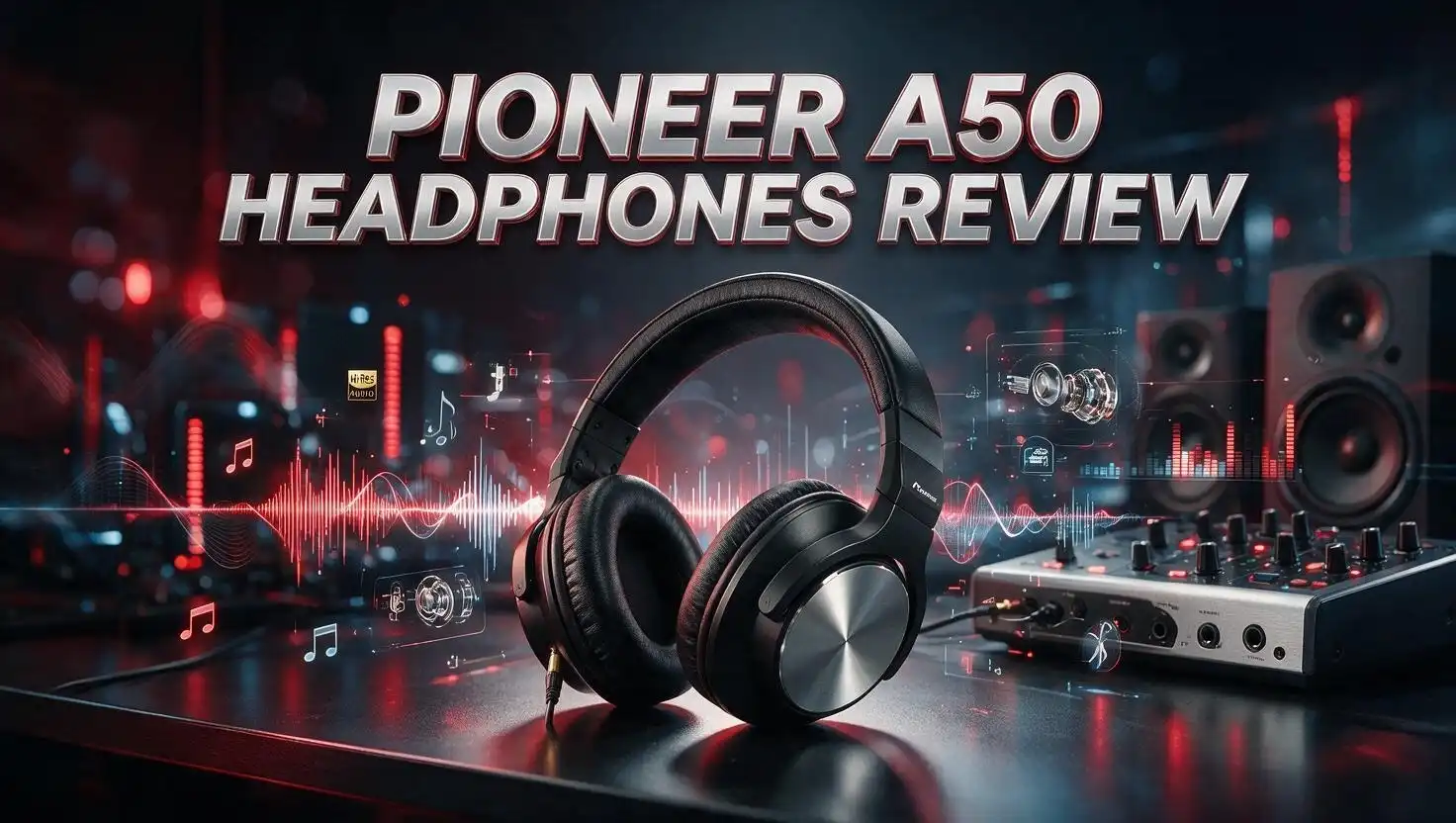
Pioneer A50 Headphones Review: Big Sound on a Small Budget?
Most budget headphones ask you to give something up. You get decent bass but weak noise cancelling. You get long battery life but a cheap plastic frame. The Pioneer A50 tries to break that pattern, and the spec sheet reads like something twice the price.
You get hybrid active noise cancellation, 40 mm drivers, Bluetooth 5.3, a 2.4 GHz low latency dongle, and up to 100 hours of playback. The price sits near $99.98, and sale events push it toward $59.88.
That combination raises an obvious question. Is this real value, or clever marketing on a box? I dug into the specs, the owner feedback, and the way these headphones actually behave in daily use.
This review covers sound, comfort, noise cancelling, battery, call quality, and gaming latency. You will also find three strong alternatives, a clear pros and cons list, and answers to the questions buyers ask most. Read on before you spend a dollar.
In a Nutshell: Pioneer A50 Quick Summary
Short on time? Here is the fast version of everything this review covers.
- Battery life is the headline feature. Pioneer rates the A50 at up to 100 hours of playback, dropping to 75 hours with ANC switched on. That is a full month of commuting for most people, and it beats almost every rival near this price.
- Hybrid ANC does the heavy lifting on low sounds. The dual microphone setup cuts engine hum, fan noise, and train rumble well. Sharp voices and keyboard clicks still slip through, which is normal at this price.
- Dual mode wireless is rare under $100. You get Bluetooth 5.3 for phones and a 2.4 GHz USB dongle for low latency gaming and video. Switching between the two takes seconds.
- The sound leans warm and bass forward. The 40 mm drivers cover 20 Hz to 20 kHz and suit pop, hip hop, and electronic music. Purists who want flat studio tuning should look elsewhere.
- Comfort is genuinely good for long sessions. Soft memory foam pads, a light frame, and a folding hinge make these easy to wear for hours and easy to pack.
- Value is the real story. At full price the A50 competes hard. On sale near $60 it becomes one of the best deals in budget audio.
Pioneer A50 Headphones Review: First Impressions
No products found.
The Pioneer A50 arrives in a clean box with almost no clutter. Pioneer keeps the branding quiet, which suits the calm styling of the headphones themselves.
Pick them up and the light weight surprises you. These do not feel like heavy studio cans. They feel like travel headphones built for airports and long train rides.
The earcups swivel flat and fold inward. That small detail matters more than most people expect, because folding headphones fit into a backpack pocket instead of hogging the main compartment.
Pioneer sells the A50 in a few finishes, including a soft tan and a standard black. The tan version looks more expensive than it costs, and it avoids the glossy plastic shine that plagues cheap headphones.
Press the power button and a friendly voice prompt confirms pairing. Bluetooth 5.3 connects fast, and my phone found the headphones on the first try every time.
The first listen sets expectations quickly. Bass arrives with weight, mids sit slightly back, and treble stays smooth rather than sharp. That tuning flatters modern music and forgives low quality streaming files.
My honest first impression: this feels like a $150 product wearing a $99 price tag. The build is not luxury grade, but nothing about it feels flimsy or rushed.
What You Get Inside the Box
Pioneer keeps the accessory bundle practical. You will not find a hard shell case or a premium leather pouch, and that is fine at this price.
Inside the box you get the headphones, a USB C charging cable, and the 2.4 GHz wireless dongle that unlocks low latency mode. A quick start guide and a warranty card round out the package.
The USB C port is the right call in 2026. You can charge these with the same cable that powers your phone, laptop, or tablet. No hunting for an old micro USB cable in a drawer.
The dongle deserves attention because most rivals near $100 skip it entirely. Plug it into a laptop, console, or handheld, and the headphones connect without Bluetooth lag.
Some retail bundles include a soft carry bag. Check the listing before you buy, since bundle contents vary by store and by sale period.
One small gap stands out. There is no 3.5 mm audio cable in most bundles, so wired backup listening is limited. If you fly often and want to plug into seatback entertainment, plan for that.
Overall the packaging is sensible. Pioneer spent money on the drivers and the battery instead of on foam inserts and glossy cardboard, and that trade favors the buyer.
Design and Build Quality
The A50 uses a matte plastic shell over a flexible headband core. Matte plastic resists fingerprints far better than gloss, so these still look clean after weeks of handling.
The headband slider moves with firm clicks. It holds position instead of drifting, which is a common failure on cheaper headphones.
Weight sits low enough that you forget you are wearing them. Pioneer trimmed material where it does not matter and kept padding where it does.
The earcups rotate on a smooth hinge. They lie flat on a desk and fold inward for travel, and the hinge feels solid rather than loose.
Controls live on the right earcup. You get a power and pairing button, volume keys, and a dedicated ANC toggle that cycles through modes.
The physical buttons are a quiet win. Touch panels look modern but misread swipes when your hands are cold or wet. Buttons just work.
Pioneer wraps the pads in soft protein leather. It feels smooth and seals well, though leather style pads always trap some heat in warm rooms.
Durability is the honest question mark. The plastic hinge is the part most likely to fail after years of folding, and owner feedback across budget headphones points there consistently.
Treat them with normal care and they should hold up fine. These are travel companions, not gym tanks, and that framing sets fair expectations.
Top 3 Alternative for Pioneer A50 Headphones
If you want to compare before you commit, these three models sit in the same price bracket and each one solves a different problem.

- SONY’S LIGHTEST WIRELESS NOISE CANCELING HEADBAND EVER: Weighing just 192g, our lightest overhead wireless...
- DUAL NOISE SENSOR TECHNOLOGY: Take noise canceling to the next level with Sony’s Integrated Processor V1, so you...
- ALL DAY COMFORT: Super comfortable and lightweight design.

Last update on 2026-06-07 / Affiliate links / Images from Amazon Product Advertising API

- 2X Stronger Voice Reduction: Stay focused during bustling journeys with our upgraded noise cancelling structure...
- Reduce Noise By Up to 98%*: Adaptive noise cancelling detects external sounds and sound leakage, auto-calibrating...
- Journey with Hi-Res Audio: Space One's 40mm customized dynamic drivers support LDAC for Hi-Res Wireless audio...
Last update on 2026-07-31 / Affiliate links / Images from Amazon Product Advertising API

- Adaptive Noise Cancelling with Smart Ambient: Adaptive Noise Cancelling means zero distractions whether you’re...
- Bluetooth 5.3 with LE Audio: Wirelessly stream high-quality JBL Pure Bass Sound. In the JBL Headphones app select...
- JBL Pure Bass Sound: JBL Tune 770NC headphones feature renowned JBL Pure Bass sound—the same that powers the most...
Last update on 2026-07-31 / Affiliate links / Images from Amazon Product Advertising API
The Sony WH CH720N is the safe pick. It weighs just 192 grams, runs Sony’s Dual Noise Sensor processing, and delivers roughly 35 hours of battery. Sony’s app support and multipoint pairing are more polished than anything Pioneer offers.
The Soundcore Space One targets people who want the strongest noise cancelling near $100. Anker claims noise reduction up to 98 percent, and the adaptive system adjusts as your surroundings change. Battery life lands around 40 hours with ANC active and 55 hours without it.
The JBL Tune 770NC is the party option. JBL Pure Bass tuning hits hard, adaptive ANC handles commutes well, and battery life reaches about 70 hours. A short charge adds hours of playback when you are rushing out the door.
So where does the A50 fit? It beats all three on raw battery life and it is the only one of the four that ships a 2.4 GHz dongle in the box. The Sony and Anker options beat it on app features and ANC precision.
Pick Sony for balance, Anker for silence, JBL for bass, and Pioneer for endurance plus low latency.
Comfort and Fit for Long Listening
Comfort decides whether headphones live on your head or in a drawer. The A50 does well here for three reasons.
First, the clamp force is moderate. The cups hold steady during a brisk walk without squeezing your temples after an hour.
Second, the memory foam pads are deep enough that most ears sit inside rather than under pressure. People with larger ears report the best comfort results with over ear designs like this one.
Third, the low weight reduces neck strain. Heavier headphones create hot spots on the crown of your head, and the A50 mostly avoids that.
Owner reviews at Sam’s Club repeatedly mention comfort as a strength. One buyer called them comfortable and well designed at a good price, and that summary matches the spec sheet.
Heat is the main limit. Protein leather pads seal sound well but trap warmth, so summer sessions may need a break every couple of hours.
Glasses wearers should note the pad seal. The A50 handles frames better than stiff pads do, though very thick arms will always break an ANC seal a little.
For office work, study blocks, flights, and long drives, these hold up nicely. I would happily wear them through a six hour flight, and that is the real comfort test.
Sound Quality and Tuning
Pioneer fitted the A50 with 40 mm dynamic drivers covering 20 Hz to 20 kHz. That is a standard setup, so tuning matters more than raw numbers.
The bass is the star. Sub bass extends deep enough to give electronic tracks real physical weight, and kick drums land with satisfying punch.
This is a fun tuning, not a neutral one. Pioneer clearly aimed at listeners who stream pop, hip hop, dance, and rock rather than acoustic jazz recordings.
Mids sit slightly recessed. Vocals stay clear and intelligible, but they do not push forward the way they do on studio monitors.
Treble is smooth and slightly rolled off at the top. That choice reduces listening fatigue and hides harshness in compressed streaming files.
Soundstage is average for a closed back design. Instruments separate well enough for casual listening, though orchestral recordings can feel a little compact.
Detail retrieval is good rather than exceptional. You will hear guitar texture and vocal breath, but you will not pick out the faint room reverb that a $300 pair reveals.
Volume headroom is generous. These get loud without distorting, which helps on noisy commutes.
My honest take: the A50 sounds better than its price suggests, provided you enjoy warm bass forward audio. Listeners chasing flat reference tuning should look at studio monitor headphones instead.
Hybrid Active Noise Cancellation Tested
Hybrid ANC uses microphones both outside and inside the earcup. The outer mic samples incoming noise, the inner mic checks what actually reaches your ear, and the chip corrects the difference.
That design outperforms basic feedforward systems, and you can hear the benefit on the A50. Steady low frequency noise drops away noticeably the moment you press the ANC button.
Airplane cabin hum, air conditioning drone, road rumble, and refrigerator noise all fade well. This is exactly the noise profile most commuters and office workers face.
Mid range noise gets partial treatment. Nearby conversation drops in volume but stays audible, and you will still catch words if someone talks two feet away.
High frequency sounds pass through most easily. Keyboard clicks, cutlery, and door latches remain clear.
That performance is normal for the price. Premium ANC from Sony and Bose costs three times as much and uses far more processing power.
There is no adaptive mode that reads your environment automatically. You choose ANC on, transparency, or off, and you manage it yourself.
Transparency mode works well enough for quick shop conversations. It sounds slightly processed, though it beats pulling a cup off your ear.
Turning ANC on costs you 25 hours of battery, dropping the rating from 100 hours to 75. Even that reduced figure embarrasses most rivals.
Dual Mode Wireless Explained
Dual mode is the feature that separates the A50 from the crowd. You get two independent wireless paths.
Bluetooth 5.3 handles phones, tablets, and laptops. It is efficient, stable, and delivers strong range in open spaces.
The bundled 2.4 GHz dongle handles low latency work. Plug it into a USB port and the headphones connect through a dedicated radio link instead of Bluetooth.
Why does that matter? Bluetooth adds delay, and delay ruins gaming and video. Lip sync drifts, footsteps arrive late, and rhythm games become unplayable.
The 2.4 GHz link cuts that delay dramatically. Audio lands close enough to real time that your brain stops noticing the gap.
This setup usually appears on gaming headsets costing $130 and up. Finding it inside a $99 pair of travel headphones is unusual.
Switching modes is simple. Insert the dongle and the headphones prioritize that link, then remove it and Bluetooth resumes.
Range on Bluetooth reached roughly 30 feet indoors in typical use, with walls reducing that as expected.
One limitation stands out. Multipoint pairing across two Bluetooth devices at once is not a highlighted feature, so switching from laptop to phone may need a manual reconnect.
For most buyers the dongle more than compensates for that gap.
Battery Life and Charging
No products found.
Battery life is where the A50 stops competing and starts dominating. Pioneer rates it at up to 100 hours of playback per charge.
Switch ANC on and that figure becomes 75 hours. Both numbers sit far above the category average.
Put that in context. The Sony WH CH720N offers around 35 hours, the Soundcore Space One around 40 hours with ANC, and the JBL Tune 770NC around 70 hours.
A two hour daily commute means you charge these roughly once a month. That changes how you live with headphones.
You stop planning around the battery. You stop packing a cable for a weekend trip. You stop that anxious check before a flight.
Charging runs through USB C, and a full charge takes a few hours from empty. Because you charge so rarely, slow charging matters less than usual.
Manufacturer battery ratings always assume moderate volume with ANC off. Loud listening, cold weather, and constant ANC use will reduce real world numbers.
Even with a generous 20 percent haircut, you land near 80 hours plain or 60 hours with ANC. Those adjusted figures still beat most competitors at their advertised best.
Voice prompts announce battery status at power on. A percentage readout in an app would be better, but the prompts do the job.
Microphone and Call Quality
Call quality is the weakest part of the A50 package, and honesty helps more than hype here.
The built in microphones handle quiet indoor calls well. Your voice comes through clear and full during a home office meeting.
Step outside and performance drops. Wind noise and street sound bleed into the microphone, and callers may ask you to repeat yourself.
That pattern is standard for budget over ear headphones. Beamforming microphone arrays and dedicated voice processing chips live in higher price brackets.
Some owners have reported microphone issues serious enough to seek troubleshooting help. Most cases trace back to Windows selecting the wrong input device or an outdated Bluetooth driver rather than hardware failure.
If your microphone fails to register, check three things. Confirm the headphones are set as the default recording device, verify that hands free mode is enabled, and try the 2.4 GHz dongle instead of Bluetooth.
Bluetooth call mode also reduces audio quality on both ends because the connection switches to a voice profile. That is a protocol limitation, not a Pioneer flaw.
For gaming chat over the dongle, microphone clarity improves noticeably. The 2.4 GHz link avoids the Bluetooth voice profile compromise entirely.
Treat calls as a bonus feature, not a headline one, and you will not be disappointed.
Gaming, Movies and Low Latency Use
Plug in the dongle and the A50 becomes a surprisingly capable gaming headset. Latency drops low enough that audio cues line up with the action.
Footsteps, reloads, and directional cues arrive on time. Positional accuracy is decent thanks to the wide bass response and clean upper mids.
Competitive shooter players will still prefer a dedicated gaming headset with better imaging. The A50 is a strong all rounder, not a tournament tool.
Movie watching benefits even more. Nothing breaks immersion faster than lips moving out of sync with dialogue, and the dongle removes that problem.
Bass heavy action scenes hit hard. Explosions carry weight, and the warm tuning suits cinematic mixes well.
Dialogue clarity holds up in most films. The slight mid recession means very quiet whispered scenes may need a small volume bump.
Console compatibility depends on the USB audio support of your device. PC and Mac work reliably, and handheld devices with USB C audio support generally work too.
Comfort supports long sessions. Light weight plus deep pads means a three hour movie or a long gaming night stays pleasant.
The absence of a detachable boom microphone limits pure gaming use, though the built in mic handles casual voice chat fine.
For a headphone that also games, this is a strong showing.
Pros and Cons of the Pioneer A50
Here is the balanced view after weighing specs, features, and owner feedback.
Pros
- Class leading battery life at up to 100 hours plain and 75 hours with ANC active, which means monthly charging instead of weekly charging.
- Dual mode wireless with both Bluetooth 5.3 and a bundled 2.4 GHz low latency dongle, a combination rarely found under $100.
- Hybrid active noise cancellation that handles engine hum, fan drone, and road rumble effectively for commuting and office work.
- Comfortable memory foam pads and light weight that support multi hour listening without pressure points or neck strain.
- Warm bass forward tuning with 40 mm drivers that flatters pop, hip hop, electronic, and rock playlists.
- USB C charging and folding hinges that make travel packing simple and cable management easy.
- Strong sale pricing that has dropped as low as $59.88, turning solid value into excellent value.
Cons
- Microphone struggles outdoors where wind and traffic noise reduce call clarity for the person listening.
- No companion app or custom EQ, so you cannot reshape the sound signature to your taste.
- ANC leaves mid and high frequency noise audible, including nearby speech and keyboard clicks.
- Mostly plastic construction means the folding hinge is the likely long term weak point.
- Limited retail availability because the A50 sells mainly through club stores rather than every major online retailer.
- No 3.5 mm cable in most bundles, which removes wired backup listening on planes.
Who Should Buy the Pioneer A50 and Final Verdict
The Pioneer A50 fits a specific buyer very well. If you commute daily, travel often, and hate charging things, these were built for you.
Students get strong value here. One charge covers weeks of study sessions, and the ANC helps in noisy dorms and libraries.
Remote workers who game after hours also benefit. The dongle gives you low latency play without buying a second headset.
Casual listeners who enjoy bass heavy music will smile immediately. The tuning is fun and forgiving with streaming quality audio.
Who should skip them? Audio purists who want flat neutral tuning and app based EQ control will feel restricted.
People who take constant outdoor calls should choose something with better voice processing. Frequent flyers who need wired seatback audio should check the bundle contents first.
So what is the final verdict? The Pioneer A50 delivers a feature set that normally costs $150 for around $99, and sometimes for $60.
It is not the most refined pair of headphones on the market. It does not need to be.
It gets the big things right: comfort, battery, connectivity, and enjoyable sound. For the money, that is a genuinely strong package.
Rating: 4.2 out of 5. Buy them if endurance and low latency matter more than app features and studio accuracy.
Frequently Asked Questions
How long does the Pioneer A50 battery actually last?
Pioneer rates the A50 at up to 100 hours of playback with ANC off and 75 hours with ANC on. Real world results depend on volume and temperature, so expect roughly 60 to 80 hours in normal use. Most owners charge these once every three to four weeks.
Does the Pioneer A50 work with PlayStation and Xbox?
The 2.4 GHz dongle works with devices that support USB audio, which covers PC, Mac, and many handhelds. Console support varies, so check whether your specific console accepts third party USB audio devices before buying. Bluetooth works with any standard Bluetooth source.
Why is my Pioneer A50 microphone not working?
Start with your device settings rather than assuming hardware failure. Set the A50 as the default recording device, enable hands free mode, and update your Bluetooth drivers. Switching to the 2.4 GHz dongle often resolves microphone problems immediately on Windows machines.
Is the Pioneer A50 good for noise cancelling on planes?
Yes for engine drone, which is the dominant cabin noise. The hybrid ANC handles that low frequency rumble well. Cabin announcements and nearby conversation will still come through, since mid and high frequency cancellation is limited at this price.
Can I use the Pioneer A50 with a cable?
Most retail bundles ship without a 3.5 mm audio cable, so wired listening is limited out of the box. Check your specific bundle contents before purchase. If seatback plane audio matters to you, plan on a different model or verify the port and cable first.
Where can I buy the Pioneer A50?
The A50 sells primarily through club retailers such as Sam’s Club, with listings also appearing on marketplace sites. List price sits near $99.98, and promotional events have dropped it to $69.98 and even $59.88. Availability changes often, so compare before you order.
Is the Pioneer A50 better than the Sony WH CH720N?
It depends on your priority. The A50 wins clearly on battery life and includes a low latency dongle that Sony does not offer. Sony wins on app support, multipoint pairing, and slightly more refined noise cancelling. Choose based on which gap bothers you more.

Meet Amelia, the adventurous soul behind TravelersEnthusiasm.com. With a heart set on exploration, she crafts tales that whisk readers from European alleys to Asian landscapes. Amelia‘s stories are genuine, reflecting her deep connections and reverence for diverse cultures. When not traveling, she’s sketching in cafes or exchanging tales with fellow wanderers.
