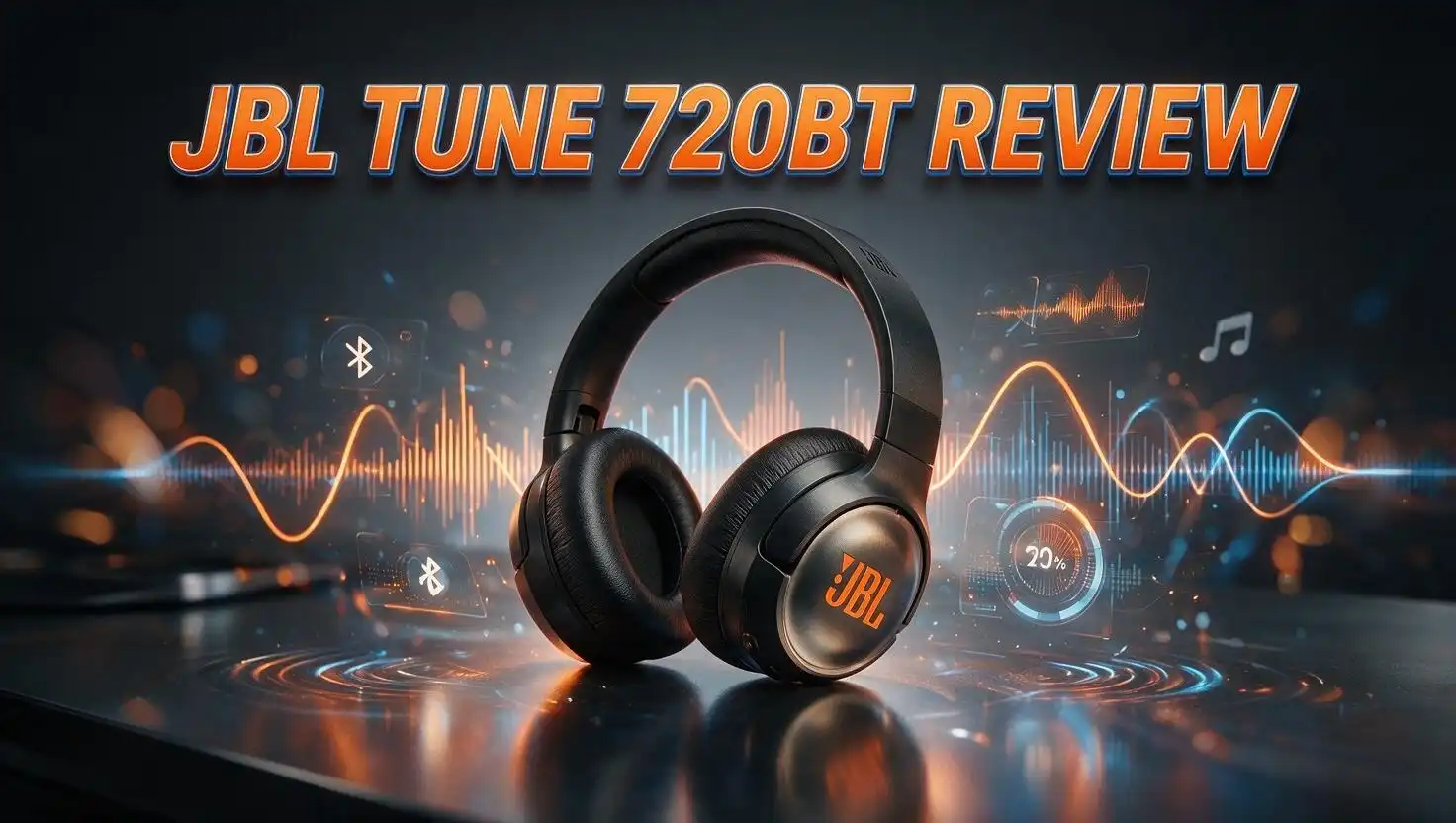
JBL Tune 720BT Review: 76 Hour Battery & Big Bass?
The JBL Tune 720BT sits in a crowded space. Dozens of budget wireless headphones fight for the same $50 to $90 shopper.
Most of them promise big sound and long battery. Very few actually deliver both.
This pair does something unusual. It runs for 76 hours on one charge and still sounds better than its price tag suggests.
But there is a catch, and it is a big one. These headphones skip active noise cancelling completely.
I dug into the full spec sheet, real owner feedback, and hands on tester data to answer one question. Should you buy the JBL Tune 720BT in 2026, or spend a little more?
Keep reading. The answer depends entirely on how you plan to use them.
In a Nutshell: JBL Tune 720BT at a Glance
Short on time? Here is everything that matters, condensed into six points.
- Battery life is the headline feature. JBL rates these at 76 hours of playback per charge. That beats almost every over ear headphone on the market, including the Sony WH-1000XM5 and the Bose QuietComfort Ultra. A five minute top up gives you three extra hours. A full charge takes about two hours over USB C.
- Sound quality punches above the price. The 40mm drivers push deep, punchy bass with the JBL Pure Bass tuning. Stock sound leans warm and slightly muffled. Two minutes inside the JBL Headphones app fixes that.
- There is no active noise cancelling. This is the single biggest limitation. You get passive isolation from the closed back design only. Airplane engines and office chatter will still reach your ears.
- They weigh just 220 grams. That is light for an over ear pair. Clamping force is strong though, and the ear cups are small, so large ears may feel squeezed.
- Bluetooth 5.3 with multipoint pairing works well. You can connect a laptop and a phone at once. Switching between them is quick and stable.
- Value is strong at sale prices. Retail sits at $89.95, but street prices drop to $49 or $59 regularly. At that price, very little competes on sound.
JBL Tune 720BT Quick Verdict

- JBL Pure Bass Sound: The JBL Tune 720BT features the renowned JBL Pure Bass sound, the same technology that powers...
- Wireless Bluetooth 5.3 technology: Wirelessly stream high-quality sound from your smartphone without messy cords...
- Customize your listening experience: Download the free JBL Headphones App to tailor the sound to your taste with...
Last update on 2026-07-31 / Affiliate links / Images from Amazon Product Advertising API
The JBL Tune 720BT is a sound first budget headphone. JBL clearly spent the budget on the drivers and the battery, then trimmed everything else.
That trade off works for some buyers and fails for others.
If you listen at home, at your desk, or on quiet walks, these are excellent. The bass hits hard. The battery basically never dies.
If you commute on a subway or fly often, you will want noise cancelling. These do not have it.
Build quality is honest for the price. The frame is mostly plastic and feels like a $50 product in the hand.
That said, the headphones fold flat and slip into a backpack easily. They also survive daily tossing around better than the plastic suggests.
Comfort is the weakest area after the missing ANC. The clamp is tight out of the box.
Most owners report it loosens after a week or two of use. Stretching them over a stack of books overnight speeds that up.
Sound wise, I would rate these around 8 out of 10 for the money. Comfort lands closer to 7.
Overall, the JBL Tune 720BT earns a solid recommendation with one clear condition. Buy them for sound and battery, not for silence.
Unboxing and First Impressions
JBL keeps the packaging simple. You get a small cardboard box with the headphones pictured on the front.
Inside, the contents are minimal but complete for the price.
You receive the headphones, a USB C charging cable, a detachable 3.5mm audio cable, a warranty card, and a quick start guide.
There is no carrying case. That is common at this price, but it still stings a little.
The included audio cable measures just 0.2 meters, which is very short. It works fine for a phone in your pocket.
For a desktop setup or an airplane seat, you will want a longer third party cable.
First impressions of the headphones themselves are positive. They feel surprisingly light the moment you pick them up.
The matte plastic finish resists fingerprints well. The JBL logo sits on each ear cup in a clean, understated way.
The hinges click firmly when you fold them. There is no wobble or creaking during normal handling.
Pairing takes under 30 seconds. Power them on, open Bluetooth settings, and they show up right away.
The voice prompt announces the connection in a clear, friendly tone. You can change the prompt language inside the JBL app.
Overall the unboxing feels appropriate for the price. Nothing feels luxurious, but nothing feels cheap enough to worry about either.
Design and Build Quality
The JBL Tune 720BT shares its design language with the pricier Tune 770NC. Side by side, most people cannot tell them apart.
That is good news and bad news at the same time.
The good news is that you get a modern, clean silhouette. The ear cups are oval, the headband is slim, and the color options include black, white, blue, and purple.
The bad news is the material. Roughly 80 to 90 percent of this headphone is plastic.
The plastic does not flex or creak much, which is reassuring. Still, the hinges are the obvious weak point over several years of use.
If you toss these into a bag without protection, a hinge could crack eventually. A cheap aftermarket case solves this for under $15.
The controls sit on the right ear cup as physical buttons. Volume up, volume down, and a multifunction button handle everything.
I strongly prefer physical buttons over touch panels at this price. Touch controls on budget headphones tend to misfire constantly.
These buttons give clear tactile feedback. You can find them by feel within a day.
The USB C port sits on the bottom of the right cup. The 3.5mm jack sits on the left.
The headband adjusts through a metal sliding rail with visible notches. It holds position well and does not slip during movement.
Folding is a two step motion. The cups rotate flat, then the arms fold inward toward the headband.
Comfort and Fit for Long Sessions
Comfort is where opinions split sharply on the JBL Tune 720BT.
At 220 grams, these are genuinely light. Weight is not the problem here.
The problem is clamping force. Out of the box, these squeeze noticeably harder than most competitors.
For the first few days, expect pressure around your temples and jaw. Anyone who wears glasses will feel it faster.
The second issue is ear cup size. The internal opening measures roughly 5.4cm tall by 3.7cm wide.
That is small for an over ear headphone. Average ears fit, but barely.
If you have larger ears, these will sit on your ears rather than around them. That changes both comfort and sound.
The padding itself is soft protein leather over foam. It feels pleasant against skin for the first hour.
Depth is only 2cm, so your ears may touch the inner driver housing. Some owners find this fine, others find it irritating.
Here is the practical advice. Break them in deliberately.
Stretch the headband gently over a shoe box or a stack of books overnight for three or four nights. The clamp softens meaningfully.
After that break in period, most owners report comfortable two to three hour sessions. Marathon eight hour workdays remain a stretch.
For gym use, the tight clamp actually becomes an advantage. These stay locked in place during movement.
Comfort verdict: good for short and medium sessions, average for all day wear.
Top 3 Alternatives for JBL Tune 720BT
If the missing noise cancelling or the tight fit worries you, three alternatives deserve a look.
Each one fixes a specific weakness of the Tune 720BT.
JBL Tune 770NC is the direct upgrade. Same design, same app, same JBL sound, plus adaptive noise cancelling and 70 hours of battery with ANC off.

- Adaptive Noise Cancelling with Smart Ambient: Adaptive Noise Cancelling means zero distractions whether you’re...
- Bluetooth 5.3 with LE Audio: Wirelessly stream high-quality JBL Pure Bass Sound. In the JBL Headphones app select...
- JBL Pure Bass Sound: JBL Tune 770NC headphones feature renowned JBL Pure Bass sound—the same that powers the most...

Last update on 2026-07-31 / Affiliate links / Images from Amazon Product Advertising API
Sony WH-CH720N trades battery life for comfort and cleaner tuning. It weighs only 186 grams, uses Sony’s processor for ANC, and runs 35 hours per charge.

- SONY’S LIGHTEST WIRELESS NOISE CANCELING HEADBAND EVER: Weighing just 192g, our lightest overhead wireless...
- DUAL NOISE SENSOR TECHNOLOGY: Take noise canceling to the next level with Sony’s Integrated Processor V1, so you...
- ALL DAY COMFORT: Super comfortable and lightweight design.
Last update on 2026-06-07 / Affiliate links / Images from Amazon Product Advertising API
Soundcore Life Q30 by Anker is the value pick for noise cancelling. It offers hybrid ANC, 40mm drivers, custom EQ in the app, 40 hours with ANC on, and a hard carrying case.

- Advanced Noise Cancellation Technology: Maintain your focus with Life Q30’s hybrid active noise cancellation...
- Ultimate Noise Cancellation Experience: Customize Life Q30’s noise cancellation with 3 modes—Transport...
- Hi-Res Music: Hear every detail of your favorite songs thanks to Life Q30’s 40mm drivers. The highly-flexible...
Last update on 2026-07-31 / Affiliate links / Images from Amazon Product Advertising API
Here is how I would choose between them.
Pick the Tune 770NC if you already like JBL sound and simply want quiet added on top. The transition is seamless.
Pick the Sony WH-CH720N if comfort matters most. It has the lightest build and the largest ear cups of the three.
Pick the Soundcore Life Q30 if you want the deepest feature set for the lowest price. The included case alone adds real value.
All three cost more than a discounted Tune 720BT. Expect to spend $30 to $60 extra for noise cancelling.
That said, if you never travel and never work in noisy spaces, the Tune 720BT still wins on pure sound per dollar.
Sound Quality and Bass Performance
Sound is the reason to buy these headphones. JBL got this part right.
The 40mm dynamic drivers cover 20Hz to 20kHz. Sensitivity sits at 101dB with 32 ohm impedance.
Those numbers mean one thing in practice. Your phone drives these easily and loudly.
Out of the box, the tuning is warm and bass forward. JBL calls this Pure Bass Sound.
The low end is deep and physical. Kick drums thump. Bass lines carry real weight.
Importantly, the bass does not turn into a muddy mess. It stays reasonably controlled compared to other bass focused budget headphones.
Mids sit slightly recessed behind that bass. Vocals can sound a touch veiled on stock settings.
Treble is safe and rolled off. Cymbals and hi hats lack sparkle, but nothing ever gets harsh or sibilant.
Soundstage is narrow, which is normal for closed back headphones at this price. Instrument separation is average.
Genre wise, these shine on hip hop, EDM, pop, and modern rock. Anything with a strong low end sounds fun here.
Acoustic music, jazz, and classical fare less well on default tuning. The recessed mids flatten those recordings.
Here is the key insight though. The stock tuning is not the final tuning.
The JBL Headphones app includes a genuinely capable equalizer. Ten minutes there transforms the sound.
After EQ, vocals push forward, the veil lifts, and detail improves noticeably. Many testers rate the post EQ sound as competitive with headphones costing twice as much.
Best EQ Settings in the JBL Headphones App
The free JBL Headphones app is the secret weapon of this product. Download it before you judge the sound.
The app includes a 10 band equalizer that is unusually flexible for a budget product.
You can drag nodes along both axes, not just up and down. That level of control is rare below $100.
Here is a simple starting point that works for most listeners.
Pull the sub bass around 60Hz down by roughly 2dB. This tightens the low end without removing punch.
Cut the muddy zone near 250Hz by 3 to 4dB. This single change removes most of the veiled quality.
Boost the upper mids around 2kHz to 3kHz by 3dB. Vocals immediately move forward and gain clarity.
Add a gentle treble lift near 8kHz of 2 to 3dB. Cymbals and detail return without becoming harsh.
Leave everything else flat.
The result is a much livelier, more balanced sound. Bass stays fun, but stops covering everything else.
The app also gives you a few other useful tools.
You can toggle Voice Aware, adjust the volume limiter, rename the headphones, and update firmware.
One important tip. Check whether the Max Volume limiter is switched on.
Many owners complain about low volume without realizing this setting exists. Turning it off adds real loudness.
The app saves your EQ profile directly to the headphones. Your settings follow you across devices.
Battery Life and Speed Charge
This is where the JBL Tune 720BT embarrasses far more expensive headphones.
JBL rates these at 76 hours of playback on a single charge.
For context, the Sony WH-1000XM5 manages 30 hours. The Apple AirPods Max manages 20.
Real world results track close to the official number. Owners consistently report 60 to 70 hours at moderate volume.
That translates to something remarkable. Most people charge these once every two to four weeks.
If you listen two hours per day, one charge lasts over a month. Battery anxiety simply disappears.
The reason for this endurance is straightforward. There is no ANC processor draining power in the background.
Charging happens over USB C. A full charge from empty takes about two hours.
The speed charge feature gives three hours of playback from five minutes plugged in. That covers a forgotten morning perfectly.
Voice prompts announce battery status at power on. The app also shows a percentage readout.
When the battery finally dies, you still have options. The detachable 3.5mm cable lets you keep listening in passive mode.
That wired mode works with no power at all. It also removes Bluetooth latency entirely.
One small note on longevity. Lithium batteries degrade over years regardless of brand.
Expect meaningful capacity after three years, though not the full 76 hours. Even at 70 percent health, that is still over 50 hours.
Bluetooth 5.3, Multipoint and Daily Controls
Connectivity is modern and reliable on the Tune 720BT.
Bluetooth 5.3 handles the wireless link. Range holds steady at roughly 10 meters indoors with walls in between.
Dropouts are rare. This is a clear improvement over older Bluetooth 5.0 budget headphones.
Supported codecs are SBC and AAC. There is no aptX or LDAC.
For most listeners this matters very little. AAC works well on iPhones, and SBC handles Android fine at higher bitrates.
Latency measures around 10 milliseconds in low latency conditions. Video playback stays in sync on YouTube and Netflix.
For competitive gaming, wired mode remains the better choice. Casual mobile gaming feels fine wirelessly.
Multipoint pairing is included, and it works smoothly.
You can hold a connection to a laptop and a phone at the same time. When a call arrives, the headphones switch automatically.
This feature alone justifies the price for remote workers. Many pricier headphones still omit it.
Controls live on the right ear cup as three physical buttons.
Single press on the center button plays or pauses. Double press skips forward. Triple press skips back.
Long press summons your voice assistant. Volume buttons do exactly what you expect.
Holding volume up or down also skips tracks on some firmware versions. Check the app for your specific mapping.
Pairing mode activates by holding the power slider. Voice prompts confirm every action clearly.
Call Quality and Voice Aware
Calls are handled by a single built in microphone. That is the bare minimum in 2026.
Expect acceptable, not impressive, results.
In a quiet room, your voice comes through clearly enough for work calls. Callers describe it as slightly thin but understandable.
In wind or street noise, quality drops fast. The single mic cannot separate your voice from background sound.
For heavy call use, a headset with multiple beamforming mics serves you better. The JBL Tune 770NC and Sony WH-CH720N both improve here.
The standout call feature is Voice Aware.
Voice Aware feeds your own voice back into the ear cups during calls. You hear yourself while talking.
This solves a real annoyance. Without it, closed back headphones make you shout without realizing it.
You can adjust the Voice Aware level inside the JBL app. Setting it around halfway feels natural for most people.
I consider this feature genuinely useful, and it is uncommon at this price.
Call controls work through the same physical buttons. One press answers or ends a call.
A long press rejects an incoming call. Two presses during a call switch to a second incoming line.
The multipoint connection makes call handling even smoother. Your phone takes priority automatically over your laptop.
Verdict on calls: fine for occasional use, weak for a call center job.
Noise Isolation and the Missing ANC
Let me be direct. The JBL Tune 720BT has no active noise cancelling.
It also has no transparency or ambient mode.
If either of those features matters to you, stop here and look at the Tune 770NC instead.
What you do get is passive isolation from the closed back design.
The tight clamping force actually helps here. A firm seal blocks more sound than a loose one.
In practice, passive isolation removes some high frequency noise. Keyboard clicks, distant conversation, and light traffic fade back.
Low frequency noise passes straight through. Bus engines, plane cabins, and air conditioning hum remain fully audible.
Playing music at moderate volume masks a good amount of that remaining noise. This is masking, not cancelling, and the difference matters.
For a quiet home office, passive isolation is entirely sufficient. For an open plan office, it is borderline.
For flights and subway commutes, it is not enough. You will end up raising the volume to unsafe levels.
Sound leakage is low. People nearby will not hear your music unless you listen very loud.
That makes these acceptable for a shared office or a library.
Here is my honest framing of the trade off.
JBL removed the ANC hardware and used that budget elsewhere. The result is better sound and far longer battery than ANC rivals at the same price.
Whether that trade works depends entirely on where you listen.
JBL Tune 720BT vs JBL Tune 770NC
These two headphones look nearly identical. The differences hide inside.
The Tune 720BT costs less, weighs 220 grams, and runs 76 hours per charge. It has no ANC.
The Tune 770NC costs $30 to $40 more, weighs 227 grams, and runs 70 hours with ANC off or 44 hours with ANC on.
Sound signature is very similar between the two. Both use JBL Pure Bass tuning and the same app EQ.
The 770NC adds adaptive noise cancelling with Smart Ambient mode. It also adds a second microphone for calls.
Noise cancelling on the 770NC is genuinely good for its price bracket. It flattens engine drone and office hum effectively.
Smart Ambient lets you hear announcements without removing the headphones. That feature is very handy in airports.
Comfort is roughly identical. Both share the same tight clamp and small ear cups.
So which one should you buy?
Choose the Tune 720BT if you listen in quiet places and want the longest battery possible. You save money and gain endurance.
Choose the Tune 770NC if you commute, travel, or work in noise. The ANC is worth every extra dollar in those conditions.
Most reviewers, including me, lean toward the 770NC as the better overall buy.
That said, when the 720BT drops to $49, the value equation flips hard. At that price it becomes very difficult to beat on sound alone.
Pros and Cons of the JBL Tune 720BT
Here is the honest summary after weighing every feature.
Pros
- Outstanding 76 hour battery life that beats nearly every over ear headphone at any price, including flagship models costing five times more.
- Strong sound quality for the money, with deep JBL Pure Bass and a warm, fun signature that suits modern music genres.
- Excellent 10 band EQ inside the JBL Headphones app that meaningfully upgrades the sound in just a few minutes of adjustment.
- Very light at 220 grams, which reduces neck and head fatigue during medium length listening sessions.
- Bluetooth 5.3 with reliable multipoint pairing, letting you stay connected to a laptop and a phone simultaneously.
- Speed charge delivers three hours of playback from five minutes plugged into any USB C source.
- Physical buttons instead of touch controls, which respond accurately every single time.
- Detachable 3.5mm cable included, so the headphones keep working with a dead battery.
- Voice Aware feature lets you hear your own voice during calls, which prevents shouting.
- Foldable design that packs flat into a backpack without taking much space.
Cons
- No active noise cancelling and no transparency mode, which rules these out for flights and loud commutes.
- Strong clamping force that causes head pressure during the first week of use.
- Small ear cup openings that press against larger ears and reduce comfort over time.
- Mostly plastic construction that feels cheap and raises long term durability questions at the hinges.
- No carrying case included, leaving the headphones unprotected in a bag.
- Only one microphone for calls, so voice quality suffers in windy or noisy places.
- No aptX or LDAC codec support, limiting wireless audio quality for high resolution listeners.
- Very short included audio cable at only 0.2 meters.
Who Should Buy the JBL Tune 720BT
- JBL Pure Bass Sound: The JBL Tune 720BT features the renowned JBL Pure Bass sound, the same technology that powers...
- Wireless Bluetooth 5.3 technology: Wirelessly stream high-quality sound from your smartphone without messy cords...
- Customize your listening experience: Download the free JBL Headphones App to tailor the sound to your taste with...
Last update on 2026-07-31 / Affiliate links / Images from Amazon Product Advertising API
These headphones fit some people perfectly and frustrate others. Here is how to tell which group you are in.
Buy the JBL Tune 720BT if you want maximum battery life. Nothing at this price comes close to 76 hours.
Buy them if you listen mostly at home or at a desk. Passive isolation handles quiet rooms just fine.
Buy them if bass matters to you. Hip hop, EDM, and pop sound genuinely enjoyable through these drivers.
Buy them if you hate charging things. One charge lasting weeks removes a real daily annoyance.
Buy them if you want the best sound per dollar under $60. After EQ, they compete with much pricier models.
Now the other side.
Skip them if you fly or commute regularly. You need real ANC, and these do not have it.
Skip them if you have large ears. The small cups will press uncomfortably within an hour.
Skip them if you take calls all day. The single microphone will not satisfy colleagues.
Skip them if you need studio accurate sound. The tuning is fun, not neutral, even after EQ.
Students, casual listeners, gym users, and home workers are the ideal buyers here.
Frequent travelers and remote workers in noisy homes should spend the extra money on the Tune 770NC instead.
Price, Value and Final Verdict
The JBL Tune 720BT carries a list price of $89.95. Almost nobody should pay that.
Street prices regularly fall to $49 to $59 during sales events. Renewed units drop even lower.
At $89, the value case is weak. Several noise cancelling rivals sit at that price.
At $59, the value case gets strong. At $49, it becomes excellent.
Set a price alert and wait for a discount. Patience genuinely pays here.
So what is the final verdict?
The JBL Tune 720BT is a specialist, not a generalist. It does two things extremely well and ignores everything else.
Those two things are sound quality and battery life. Both are best in class for the money.
The missing ANC is a real limitation, not a minor footnote. Judge your listening environment honestly before buying.
Build quality is adequate but not confidence inspiring. Handle them with reasonable care and use a case.
Comfort improves after a break in period, though large ears will never be fully happy.
My overall score lands around 7 out of 10. That rating rises to nearly 8 at sale prices.
If you want one recommendation, here it is. Buy the Tune 720BT on sale for casual and home listening. Upgrade to the Tune 770NC if silence matters.
Either way, JBL has built two of the more sensible budget headphones available right now.
Frequently Asked Questions
Does the JBL Tune 720BT have noise cancelling?
No. The JBL Tune 720BT has no active noise cancelling and no transparency mode.
It offers passive noise isolation only, thanks to the closed back ear cup design. For active noise cancelling, look at the JBL Tune 770NC instead.
How long does the JBL Tune 720BT battery actually last?
JBL rates the battery at 76 hours of playback. Real world testing typically lands between 60 and 70 hours at moderate volume.
A five minute charge adds three hours of listening. A full charge from empty takes about two hours over USB C.
Is the JBL Tune 720BT good for gaming?
For casual gaming, yes. Latency measures around 10 milliseconds, which keeps audio reasonably in sync.
For competitive gaming, use the included 3.5mm cable. Wired mode removes wireless latency entirely.
Can you use the JBL Tune 720BT while charging?
Yes, but only in wired mode using the 3.5mm audio cable. Bluetooth playback pauses while the headphones charge over USB C.
Why is my JBL Tune 720BT so quiet?
Open the JBL Headphones app and check the Max Volume limiter setting. Many owners leave this switched on without realizing it.
Turning the limiter off increases maximum loudness noticeably. Applying a small EQ boost also raises perceived volume.
Is the JBL Tune 720BT waterproof?
No. JBL lists the Tune 720BT as water resistant, not waterproof, and there is no official IP rating.
Light sweat and a few raindrops are fine. Never submerge them or wear them in heavy rain.
JBL Tune 720BT vs Tune 710BT: which is better?
The Tune 720BT is the newer model and the better choice overall. It adds Bluetooth 5.3, multipoint pairing, Voice Aware, and 76 hours of battery.
The Tune 710BT offers 50 hours and older Bluetooth 5.0. Both share similar sound signatures.
Does the JBL Tune 720BT come with a case?
No carrying case is included in the box. You get the headphones, a USB C cable, a short audio cable, and paperwork.
Affordable third party cases are widely available and worth buying for protection.
How do you reset the JBL Tune 720BT?
Power the headphones on, then press and hold the volume up and volume down buttons together for around five seconds. A voice prompt confirms the reset.
After resetting, remove the old pairing from your device before connecting again.

Meet Amelia, the adventurous soul behind TravelersEnthusiasm.com. With a heart set on exploration, she crafts tales that whisk readers from European alleys to Asian landscapes. Amelia‘s stories are genuine, reflecting her deep connections and reverence for diverse cultures. When not traveling, she’s sketching in cafes or exchanging tales with fellow wanderers.